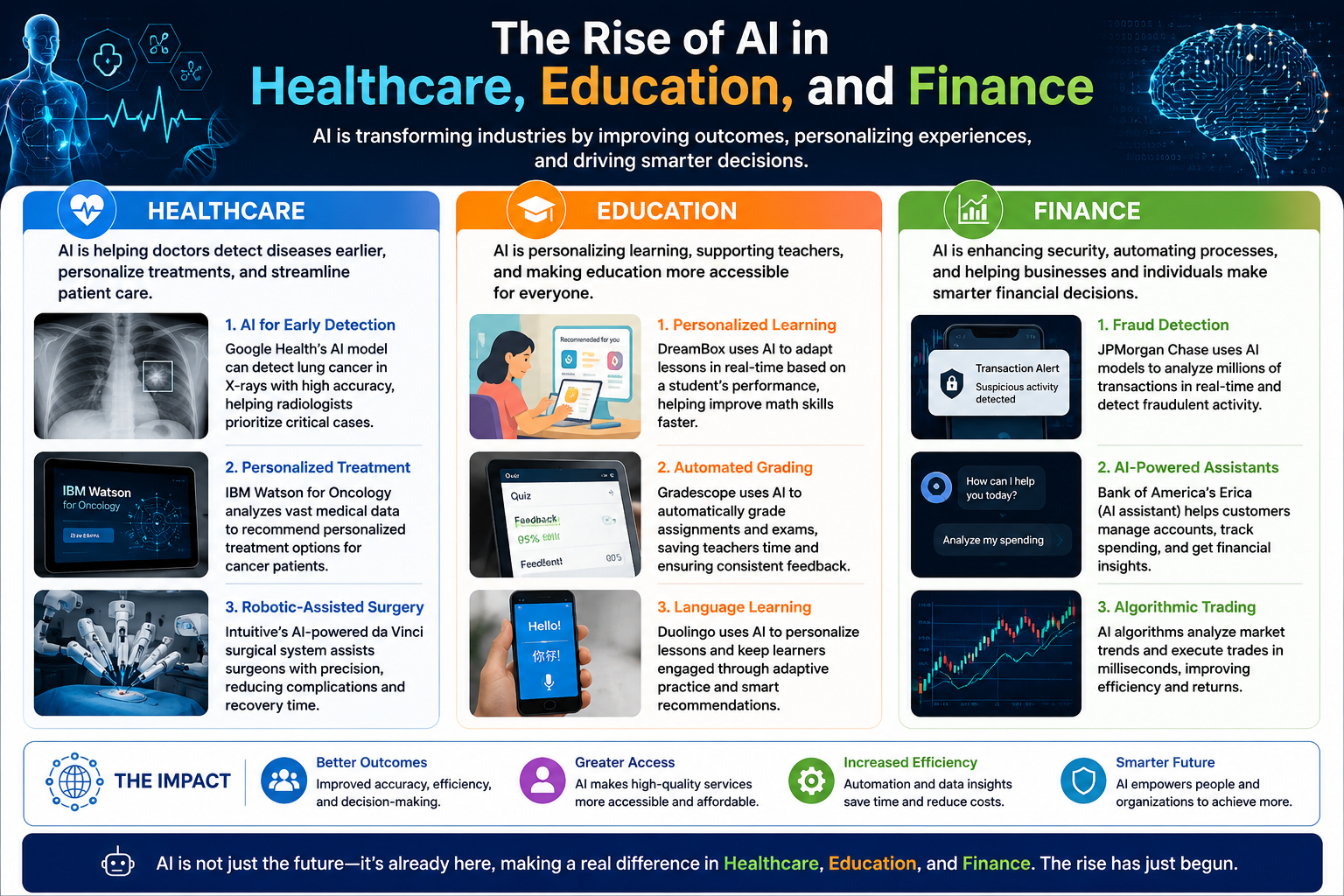
Artificial intelligence has officially crossed the threshold from an experimental software stack into a foundational, systemic utility. We have moved far beyond the initial hype cycle of text chatbots making conversation or generating digital art. In 2026, advanced machine learning architectures, autonomous agent workflows, and low-latency inference engines are embedded directly into the backbone of global enterprise infrastructure.
From hospital emergency rooms and university classrooms to global payment networks, automated systems are handling high-stakes, real-time workflows that directly impact human lives, financial liquidity, and societal development. This isn’t theoretical—it is an operational reality. Here is an in-depth analysis of how AI is actively functioning across three critical pillars of global society: Healthcare, Education, and Finance.
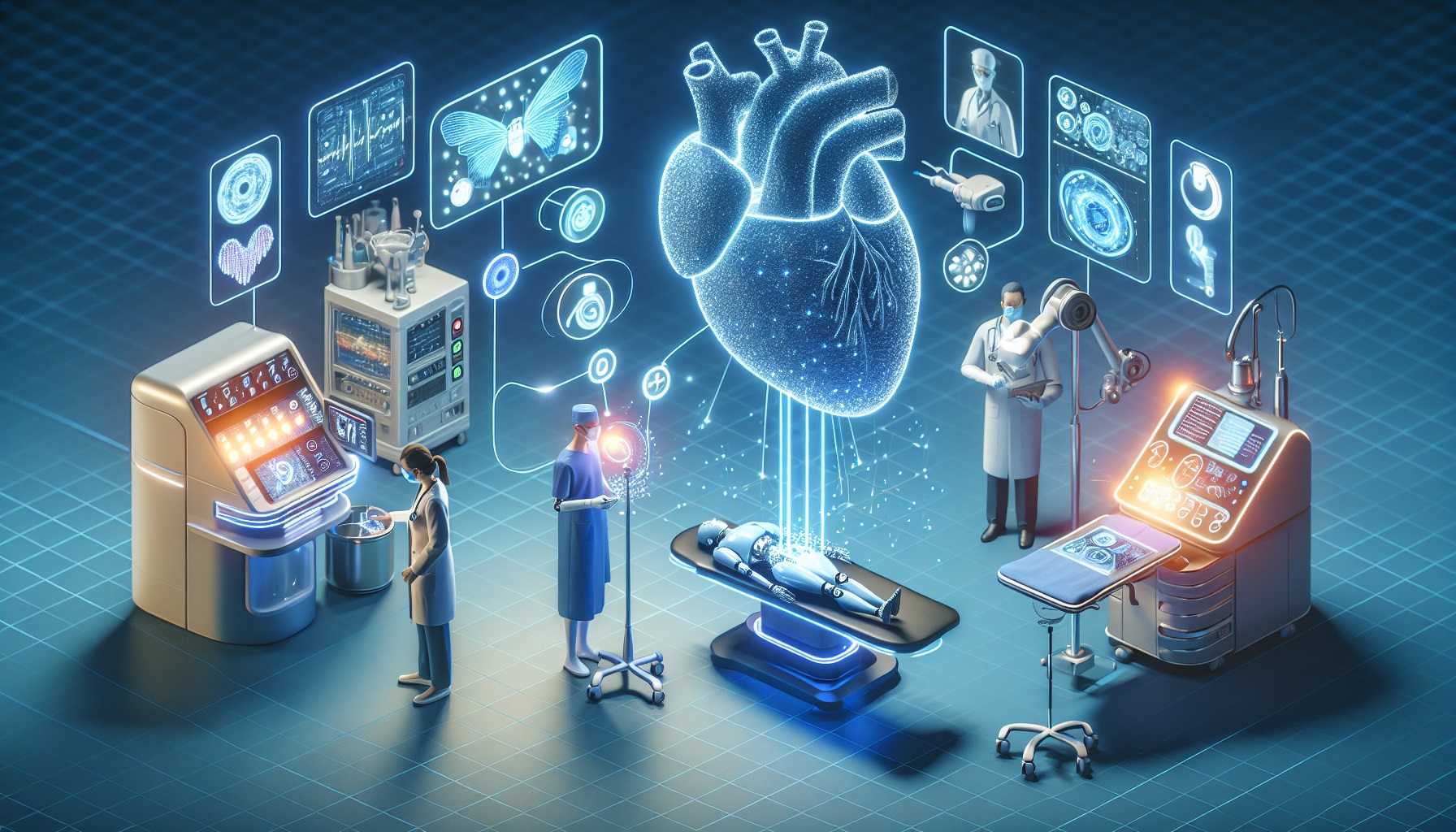
1. Healthcare: Transitioning to Preventive Diagnostics and Accelerated R&D
In modern clinical environments, artificial intelligence functions primarily as a high-velocity systems optimizer. By processing multi-layered, multi-modal data streams, AI models reduce diagnostic bottlenecks, optimize clinical triage, and accelerate drug discovery timelines.
Early-Stage Triage & Computer Vision in Radiology
One of the most immediate operational wins in hospital networks is the integration of computer vision platforms (such as Aidoc and Viz.ai) directly into radiology PACS (Picture Archiving and Communication Systems) workflows.
Historically, medical imaging followed a linear, first-come-first-served review queue. An emergency room patient with a subtle intracranial hemorrhage or pulmonary embolism might wait hours while a radiologist worked through routine scans. Modern AI engines process incoming CT and MRI scans in real time, automatically scanning for life-threatening anomalies. High-risk scans are instantly flagged and prioritized at the top of the radiologist’s queue, reducing critical diagnostic turnaround times from nearly an hour down to under 15 minutes.
Privacy-Preserving Risk Prediction via Federated Learning
A major hurdle in healthcare technology has always been data privacy and regulatory compliance under strict frameworks like HIPAA and GDPR. Medical data cannot simply be pooled into a centralized cloud server for training without significant legal risk.
Healthcare consortia (such as AI4HealthyAging) solve this through federated learning—a decentralized machine learning approach where the core algorithm travels to local hospital servers, trains on on-premise clinical records, and sends only encrypted model weights back to a central orchestrator. This allows predictive models to analyze patient clinical histories across diverse global populations to detect early risk signals for stroke, heart failure, and oncology markers—all without physically moving or exposing sensitive patient records.
AI-Guided Drug Formulation & Virtual Screening
In pharmaceutical R&D, legacy drug discovery required years of manual wet-lab iterations to identify viable small molecules. During major therapeutic development programs, pharmaceutical leaders like Pfizer leveraged AI-driven virtual screening algorithms to simulate millions of chemical interactions in silico. By modeling molecular binding affinities and predicting target potencies computationally, researchers shrank molecular development cycles from years down to months.
2. Education: Scaling Adaptive Instruction and Institutional Efficiency
The integration of generative AI into education centers on moving away from rigid, one-size-fits-all curricula toward personalized, adaptive learning architectures.
Intelligent Tutoring Systems (ITS) & Pedagogical Agents
Traditional digital learning tools relied on static worksheets and linear multiple-choice quizzes. Modern educational frameworks deploy dialogue-based pedagogical engines powered by natural language processing (NLP). These intelligent tutoring systems act as continuous academic mentors:
-
Dynamic Speed Adaptation: The system measures a student’s response velocity and conceptual retention, automatically slowing down or accelerating the pace of material.
-
Precise Error Diagnostics: Rather than simply marking an algebra problem incorrect, the AI analyzes the student’s step-by-step logic, identifies the exact underlying misconception (e.g., misapplying the distributive property), and offers tailored remedial hints.
Automated Content Segmentation & Educator Leverage
Administrative overhead and lesson preparation consume an enormous percentage of a teacher’s work week. Platforms like Engageli Studio utilize automated content segmentation to transform passive lecture videos and dense textbooks into interactive micro-learning modules:
-
Semantic Parsing: The AI breaks long lecture recordings into 3- to 5-minute core conceptual segments.
-
Contextual Knowledge Checks: The engine automatically inserts relevant, open-ended comprehension questions at key timestamps.
-
Engagement Analytics: Teachers receive real-time dashboards highlighting which concepts caused student hesitation, allowing them to adjust live classroom instruction accordingly.
Data Takeaway: According to research from international education groups (including OECD tracking), teachers utilizing AI-assisted lesson preparation and administrative automation recover 3 to 5 hours per week, which can be redirected toward direct student mentorship and emotional support.
3. Finance: Millisecond Fraud Interception and Alternative Underwriting
The financial sector relies on AI to process massive, high-velocity transactional telemetry in real time—mitigating systemic risk, democratizing credit access, and optimizing corporate liquidity.
Millisecond Fraud Interception
Legacy fraud detection relied heavily on static, rule-based heuristics (e.g., “block any transaction over $5,000 made outside the home country”). These rigid rules suffered from high false-positive rates—frustrating legitimate cardholders while failing to catch sophisticated cybercriminals.
Modern payment networks (such as Mastercard’s Decision Intelligence) process transactions using real-time machine learning pipelines. As shown in event-driven streaming architectures (using Kafka and TensorFlow models), every swipe or digital transfer evaluates hundreds of contextual variables simultaneously:
-
Behavioral Biometrics: Device tilt, typing rhythm, and navigational interaction patterns.
-
Geopolitical & Velocity Signals: Physical distance between sequential swipes and merchant risk scoring.
-
Predictive Graph Analysis: Inter-account mapping to spot coordinated money laundering rings.
This multi-dimensional scoring happens in under 50 milliseconds, blocking fraudulent transfers globally before funds change hands while drastically reducing false declines.
Alternative Credit Underwriting
Traditional credit scoring models rely on credit bureau histories, which inherently exclude young adults, gig economy workers, and cash-dominant populations in emerging markets.
Fintech platforms (such as Lendingkart and KreditBee) utilize machine learning models to ingest non-traditional data streams:
-
Utility and telecommunications bill payment consistency.
-
Real-time cash flow and digital merchant terminal velocity.
-
Micro-transaction stability and seasonal business revenue trends.
By replacing static credit scores with dynamic cash-flow underwriting, financial institutions can accurately extend credit to millions of creditworthy individuals and small businesses previously ignored by legacy banking rules.
Sector Transformation Overview
To evaluate how these systems compare across operational environments, consider the core machine learning mechanisms and their practical benchmarks:
| Industry Sector | Primary Machine Learning Mechanism | Key Operational Benchmark | Primary Human Oversight Role |
| Healthcare | Computer Vision, Federated Learning, Molecular Simulation | Radiology triage timelines reduced from ~50 mins to under 15 mins. | Final diagnostic confirmation and patient bedside care. |
| Education | Natural Language Processing, Adaptive Dialogue Engines | Student engagement metrics increase by up to 60% via adaptive micro-lessons. | Mentorship, emotional support, and pedagogical strategy. |
| Finance | Multi-Signal Behavioral Scoring, Event-Stream Inference | Sub-50ms fraud interception; major reduction in false-positive declines. | Risk policy governance and complex dispute resolution. |
Final Perspective: AI as an Infrastructural Layer
The evolution across healthcare, education, and finance proves that artificial intelligence has evolved far beyond novelty tools. When built upon robust data pipelines, strict privacy compliance, and clear human-in-the-loop guardrails, AI serves as an essential infrastructural layer for global enterprise.
The most successful implementations do not aim to replace human judgment; they eliminate operational friction, expand access, and empower human professionals to operate at their highest potential.