In 2026, the question is no longer “which AI model is better” in the abstract. It is: “Which model is the most cost-effective, secure, and performant tool for the specific job in front of you?”
Just two years ago, the capability gap between open-source (open-weight) models like Meta’s Llama series and proprietary frontier models like OpenAI’s GPT or Anthropic’s Claude felt like a vast chasm. Today, that gap has narrowed into a strategic fork in the road. According to industry benchmarks, open-weight models have reached performance parity on nearly 90% of standard enterprise tasks.
As a result, high-performing organizations have stopped picking sides. Instead of betting on a single vendor, forward-thinking engineering teams are constructing hybrid AI stacks—routing requests dynamically between closed frontier APIs and fine-tuned, self-hosted open models.
Here is an in-depth breakdown of the open vs. closed landscape in 2026, the unit economics driving the shift, and how to design a modern AI model stack.
1. Closed-Source Models: The “Frontier Reasoning” Layer
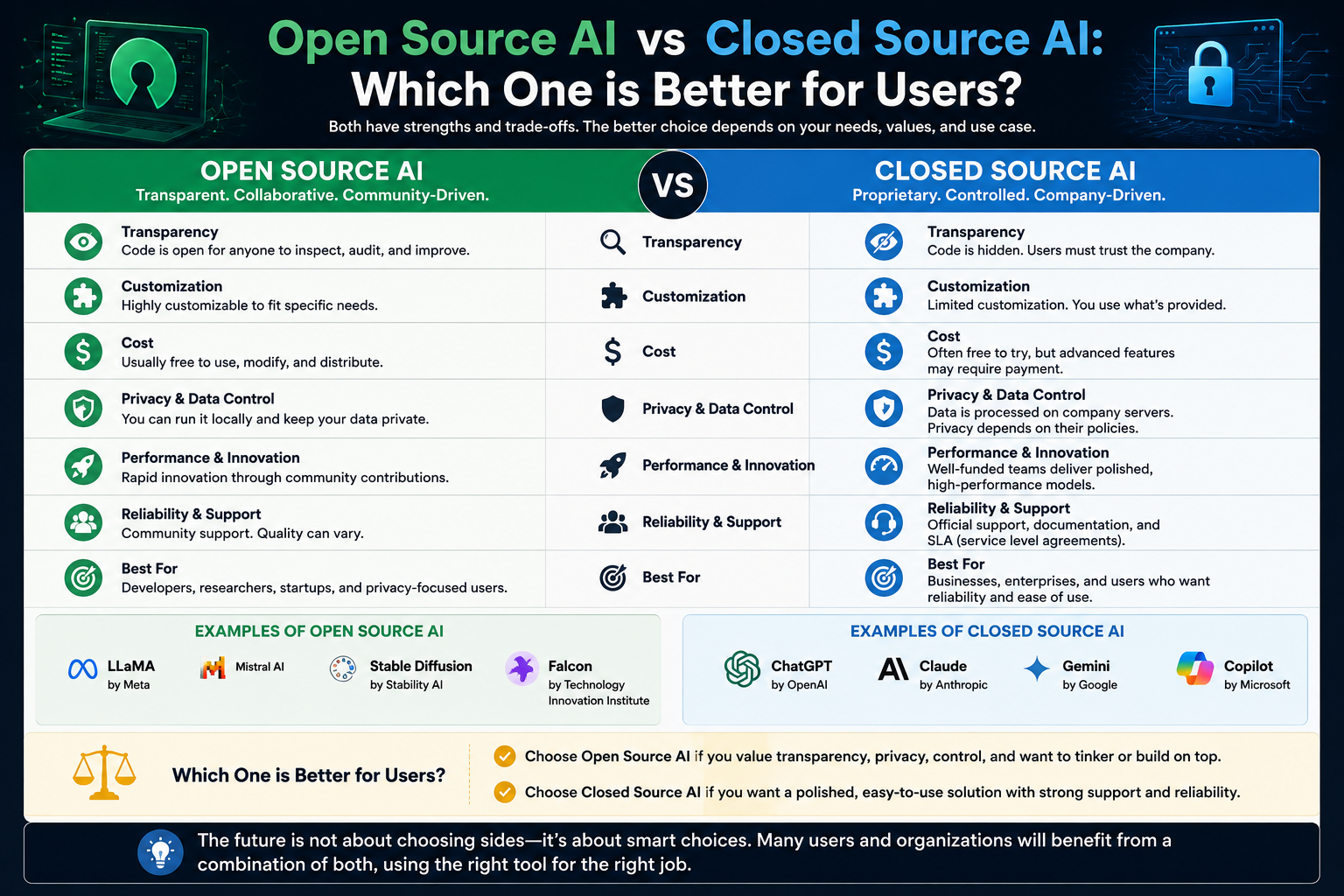
Closed-source (proprietary) models—such as OpenAI’s GPT-5.5, Anthropic’s Claude Opus 4.8, and Google’s Gemini 3.5 Pro—remain the luxury option in artificial intelligence. You are paying premium API rates for a managed, polished engine that requires zero GPU orchestration or hardware maintenance on your end.
Why You Choose Closed Models
-
Frontier Logic & Long-Horizon Reasoning: For the absolute hardest tasks—like multi-file software architecture, complex scientific hypothesis testing, or multi-step agentic orchestrations—the bleeding-edge performance crown still sits with top-tier closed labs.
-
Zero Infrastructure Overhead: Prototyping is instant. You call an endpoint, pay per token, and offload all load balancing, latency optimization, and red-teaming safety filters to the provider.
-
Deep Platform Integration: Proprietary models are baked directly into productivity suites like Microsoft 365 Copilot, Google Workspace, and enterprise dev environments.
The Trade-off: Proprietary models operate as “black boxes”. You have zero control over underlying weight weights, remain subject to vendor rate limits and pricing changes, and must transmit your data over third-party networks.
2. Open-Source Models: The “Sovereignty & Scale” Layer
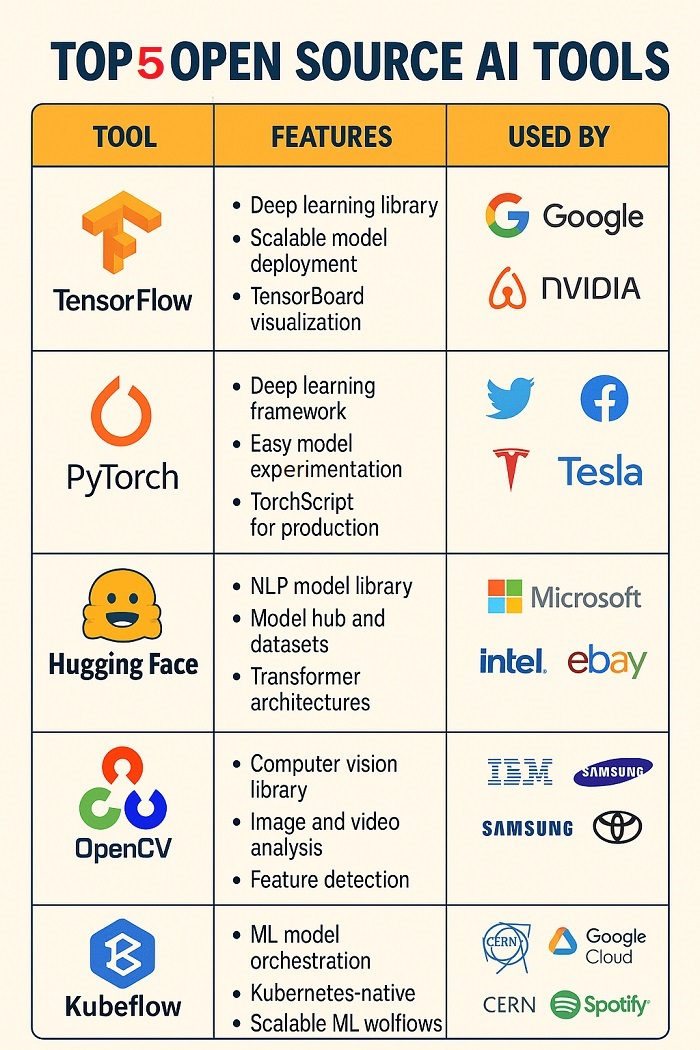
Open-weight models—anchored by Meta’s Llama 4, DeepSeek V4, Mistral Large, and Alibaba’s Qwen 3—have transitioned from experimental novelties to production-grade workhorses. They do not just lower token costs; they offer architectural freedom that proprietary APIs fundamentally cannot deliver.
Why You Choose Open-Weight Models
-
Data Privacy & Sovereignty: For regulated industries handling sensitive medical records, proprietary source code, or confidential customer telemetry, open weights allow deployment on private clouds or air-gapped on-premise hardware. Your data never touches an external API.
-
Unrestricted Fine-Tuning: You can adapt open-weight models directly on your private domain data—teaching them your company’s internal nomenclature, unique coding patterns, or compliance workflows without external alignment filters interfering.
-
Predictable Fixed-Cost Infrastructure: Rather than paying variable per-token API taxes that scale indefinitely with user traffic, self-hosting shifts inference to a flat infrastructure cost.
The Trade-off: Open models shift the burden of “plumbing” to your engineering team. You are responsible for GPU provisioning, inference optimization (vLLM, TensorRT-LLM), fallback logic, and security guardrails.
3. The Unit Economics of Scale: The “Chief Token Officer” Math
The transition from closed APIs to open weights is increasingly driven by financial logic. In many organizations, the Chief Financial Officer (CFO) has effectively become the “Chief Token Officer,” scrutinizing API bills that grow linearly with product usage.
Consider a high-volume enterprise Retrieval-Augmented Generation (RAG) pipeline processing millions of tokens monthly for internal search, document classification, and support ticketing:
  CLOSED API PIPELINE (Frontier Pricing):
  10,000,000 Tokens/Mo  ×  $0.00025/Token  =  ~$2,500 / Month

  HYBRID OPEN-WEIGHT PIPELINE (Hosted vLLM Instance):
  Fixed Cloud GPU Cost + Storage           =  ~$180 / Month
  ────────────────────────────────────────────────────────────
  ESTIMATED MARGIN RECOVERY:               > 90% Cost Reduction
While closed APIs remain ideal for low-volume, high-value decision nodes, running repetitive background tasks through expensive frontier models creates an unnecessary tax on product margins.
4. Comprehensive Architectural Comparison
To clarify deployment trade-offs, here is how closed-source and open-source models compare across core operational vectors:
5. The 2026 Reality: Building the Hybrid Stack
The most efficient engineering organizations in 2026 do not choose one paradigm exclusively. They build a smart model router that directs traffic dynamically across three operational tiers:
Strategic Takeaway for Builders
If you are a founder, developer, or enterprise architect, avoid ideological dogmatism.
-
Start with Closed Models: Use frontier APIs (GPT, Claude, Gemini) to rapidly prototype your feature, prove user demand, and solve complex reasoning hurdles without building infrastructure.
-
Optimize with Open Weights: Once a specific task reaches high token volume and predictable prompt structures, benchmark a fine-tuned open-weight model (Llama, DeepSeek). If it achieves 92% of the performance for 10% of the cost while improving data privacy, transition that node to open weights.
That dual-engine strategy is how market leaders win in 2026—combining the raw intelligence of the frontier with the unit economics and privacy of open-source software.