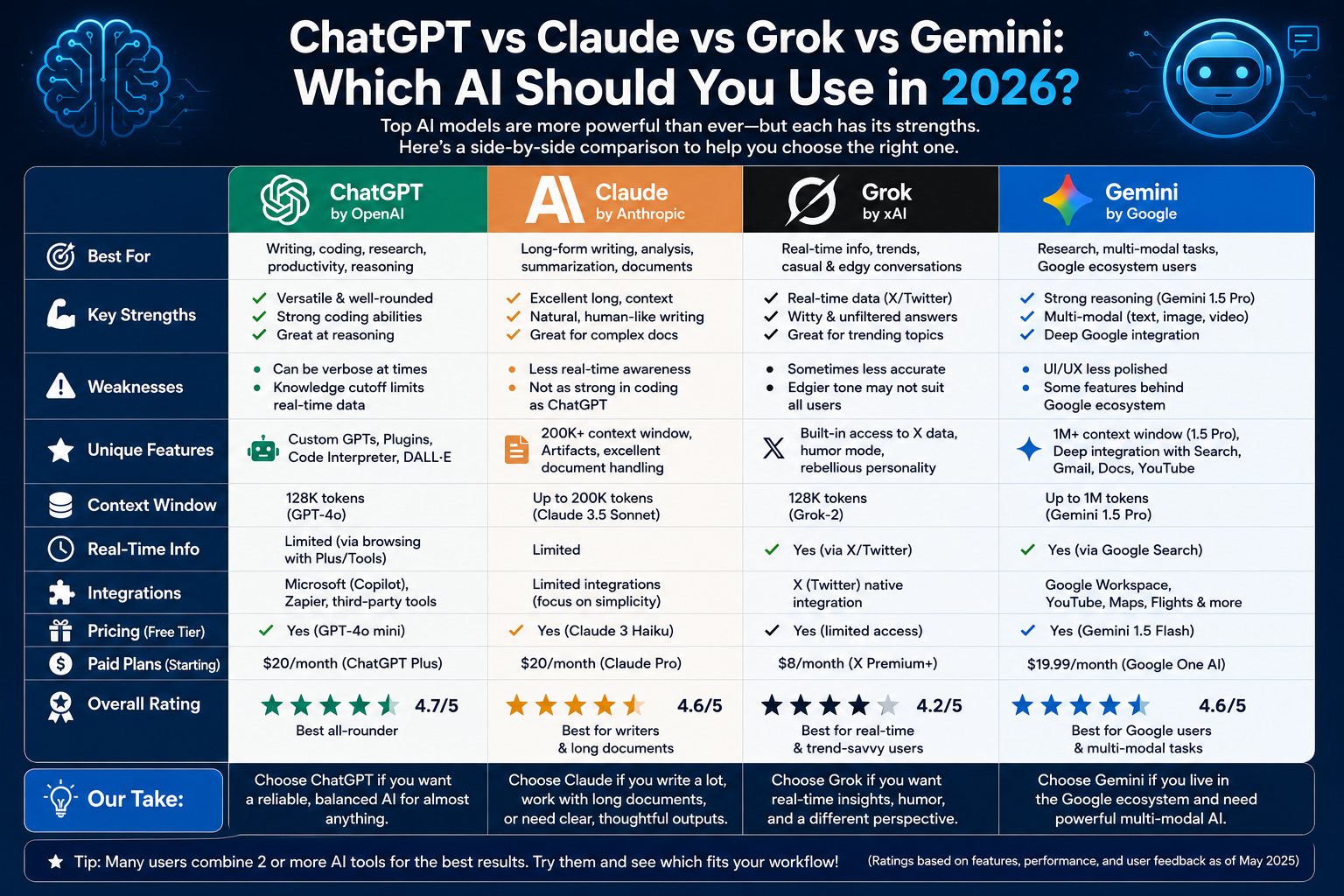
The 2026 Frontier AI Landscape: ChatGPT vs. Claude vs. Grok vs. Gemini (An Unfiltered Practitioner’s Guide)
The landscape of frontier AI models has shifted dramatically. We have officially moved past the era of generic chat boxes; in 2026, the major AI powerhouses have differentiated into highly specialized, domain-dominant engines.
Trying to pick a single “best AI model” today is like asking whether a sports car, a heavy-duty pickup truck, a cargo plane, or a speed boat is the superior vehicle. It depends entirely on what terrain you are trying to navigate—whether that is running autonomous software agents, writing production-ready code, tracking live global trends, or processing gigabytes of raw multimedia data.
Here is an in-depth, practitioner-first breakdown of how the “Big Four” stack up right now, their distinct superpowers, trade-offs, and exactly how to orchestrate them for maximum leverage.
1. ChatGPT (OpenAI): The Operational Ecosystem & Orchestrator
OpenAI’s flagship lineup continues to lead the industry when it comes to raw operational versatility, tool integration, and agentic task completion. While competitors have surpassed it in isolated niche benchmarks, ChatGPT remains the most polished “digital nervous system” for managing complex workflows.
The Superpower: Agentic Orchestration
ChatGPT excels at taking ambiguous, high-level directives and decomposing them into structured, executable sub-tasks. It handles multi-step reasoning, tool execution (browser, Python sandbox, API calls), and recursive error correction without drifting away from the core goal.
The Interface & Practical Edge
-
Advanced Voice Mode: Provides fluid, near-zero latency conversational interaction with real-time vocal nuance, making it an invaluable sounding board during active brainstorming or hands-free execution.
-
Native Data Analysis: Parses multi-sheet workbooks, cleans messy tabular data, executes inline statistical scripts, and generates interactive visual reports seamlessly.
-
Canvas Interface: Offers an interactive side-by-side workspace for co-editing text and code iteratively.
Ideal Use Cases
-
Building multi-agent pipelines and cross-functional task delegation.
-
Enterprise process automation and operational project management.
-
Interactive brainstorming, real-time voice coaching, and rapid prototyping.
Practitioner’s Take: Treat ChatGPT as your Operations Manager. It may not write the absolute cleanest niche code or fetch the freshest social media memes, but it coordinates moving parts better than anything else on the market.
2. Claude (Anthropic): The Nuanced Intellect & Coding Powerhouse
Anthropic has solidified its reputation as the developer’s secret weapon. By focusing relentless research on structural reasoning, extended thinking, and human-aligned nuance, Claude has become the uncontested standard for software engineering and dense document analysis.
The Superpower: System Architecture & Natural Prose
Claude (led by models like Opus and Sonnet) delivers superior performance in multi-file software engineering, legacy code refactoring, and complex architectural design. When generating written content, it exhibits an organic, elevated style that bypasses the repetitive “AI jargon” (words like delve, testament, tapestry, spearhead) that typically marks synthetic text.
The Interface & Practical Edge
-
Artifacts Workspace: A dedicated UI panel that renders live code execution, interactive web components, SVG graphics, and architectural diagrams directly beside the chat.
-
Extended Thinking (Reasoning Trace): Explicitly exposes the model’s internal step-by-step logic, letting you audit how it arrived at a complex engineering or mathematical conclusion.
Ideal Use Cases
-
Full-stack software engineering, bug tracking, and code refactoring.
-
Deep literary analysis, long-form policy review, and academic syntheses.
-
Drafting executive communications, speeches, and nuanced marketing copy.
Practitioner’s Take: Treat Claude as your Lead Software Architect and Senior Editor. If a task requires surgical precision, logical consistency, or beautiful human prose, Claude is the default choice.
3. Grok (xAI): The Real-Time Context & Event Engine
Operating directly within the xAI ecosystem, Grok’s structural advantage stems from its uninhibited access to live global data streams, real-time telemetry, and social media signals.
The Superpower: Live Information Velocity
While standard AI models rely on periodic web search indexing that can lag behind fast-moving news, Grok ingests, filters, and synthesizes live events as they transpire on the ground. It identifies emerging cultural shifts, breaking market updates, and viral sentiment before traditional search engines even index them.
The Interface & Practical Edge
-
Unfiltered & Direct Tone: Offers a togglable persona that strips away hyper-cautious corporate fluff in favor of direct, punchy, and candid responses.
-
Native X (Twitter) Integration: Direct access to real-time posts, community notes, and trend telemetry.
Ideal Use Cases
-
Real-time financial market tracking and sentiment monitoring.
-
Social media strategy, trend forecasting, and cultural analysis.
-
Gathering fast, candid pulse checks on breaking technical or global news.
Practitioner’s Take: Treat Grok as your Field Journalist and Trend Monitor. When speed and real-time situational awareness matter more than formal documentation, Grok provides a fast, direct window into the world.
4. Gemini (Google): The Multimodal Heavyweight
Google’s native multimodal architecture allows Gemini to process text, high-definition video, raw audio streams, and visual diagrams simultaneously—without converting them through separate sub-models.
The Superpower: Massive Context Windows & Native Multimodality
With an active context window spanning 1 million to 2+ million tokens, Gemini allows you to upload an hour of 4K video, entire codebase repositories, or thousands of pages of financial PDF reports in a single prompt. You can then cross-examine the data, ask for exact timestamps, or request visual extractions within seconds.
The Interface & Practical Edge
-
Google Workspace Synergy: Deep, native integration with Google Docs, Drive, Gmail, Maps, and YouTube, making it an effortless extension of everyday productivity stacks.
-
Native Video & Spatial Understanding: Can “watch” video recordings of user testing sessions, lectures, or physical machinery and provide pinpoint spatial and chronological analysis.
Ideal Use Cases
-
Video production, timestamping, and media editing workflows.
-
Deep-dive research across massive document archives or code repositories.
-
Integrated enterprise productivity within Google Workspace ecosystems.
Practitioner’s Take: Treat Gemini as your Research Director and Media Specialist. No other model can analyze hours of video or mountain-sized document sets with the same ease and speed.
The 2026 Selection Matrix
To streamline your daily decision-making, match your immediate bottleneck to the model optimized to solve it:
| Primary Workflow Need | Recommended Model | Core Advantage | Target User |
| Heavy Software Engineering | Claude (Anthropic) | Highest SWE-bench benchmarks & Artifacts workspace. | Developers, CTOs, Technical Writers |
| Multi-Agent & Tool Orchestration | ChatGPT (OpenAI) | Robust tool pipelines, Canvas, & Advanced Voice. | Product Managers, Founders, Operations |
| Long Video & Huge Datasets | Gemini (Google) | Up to 2M token context window & native video analysis. | Researchers, Media Editors, Analysts |
| Real-Time News & Cultural Trends | Grok (xAI) | Direct social telemetry & real-time live event streaming. | Marketers, Financial Traders, Journalists |
Building a High-Leverage Multi-Model Workflow
The most effective creators and technical teams in 2026 do not restrict themselves to a single subscription. Instead, they build a hybrid orchestration model that routes tasks to the appropriate engine:
-
Research & Data Ingestion (Gemini): Feed raw video recordings, audio interviews, or 500-page PDF reports into Gemini to extract core themes and detailed timestamps.
-
Architecture & Execution (Claude): Pass the extracted specs to Claude to architect clean codebases, draft technical documentation, or write polished long-form drafts.
-
Workflow & Deployment (ChatGPT): Use ChatGPT to build automation scripts, manage multi-tool integration, and organize project sprints.
-
Market Validation & Pulse (Grok): Run the final output through Grok to sense-check against real-time industry sentiment and live news trends.
Final Takeaway
The “best AI model” title is officially obsolete. Mastery in 2026 isn’t about finding one tool to rule them all—it’s about knowing which specialist to pull into the conversation at the right moment.