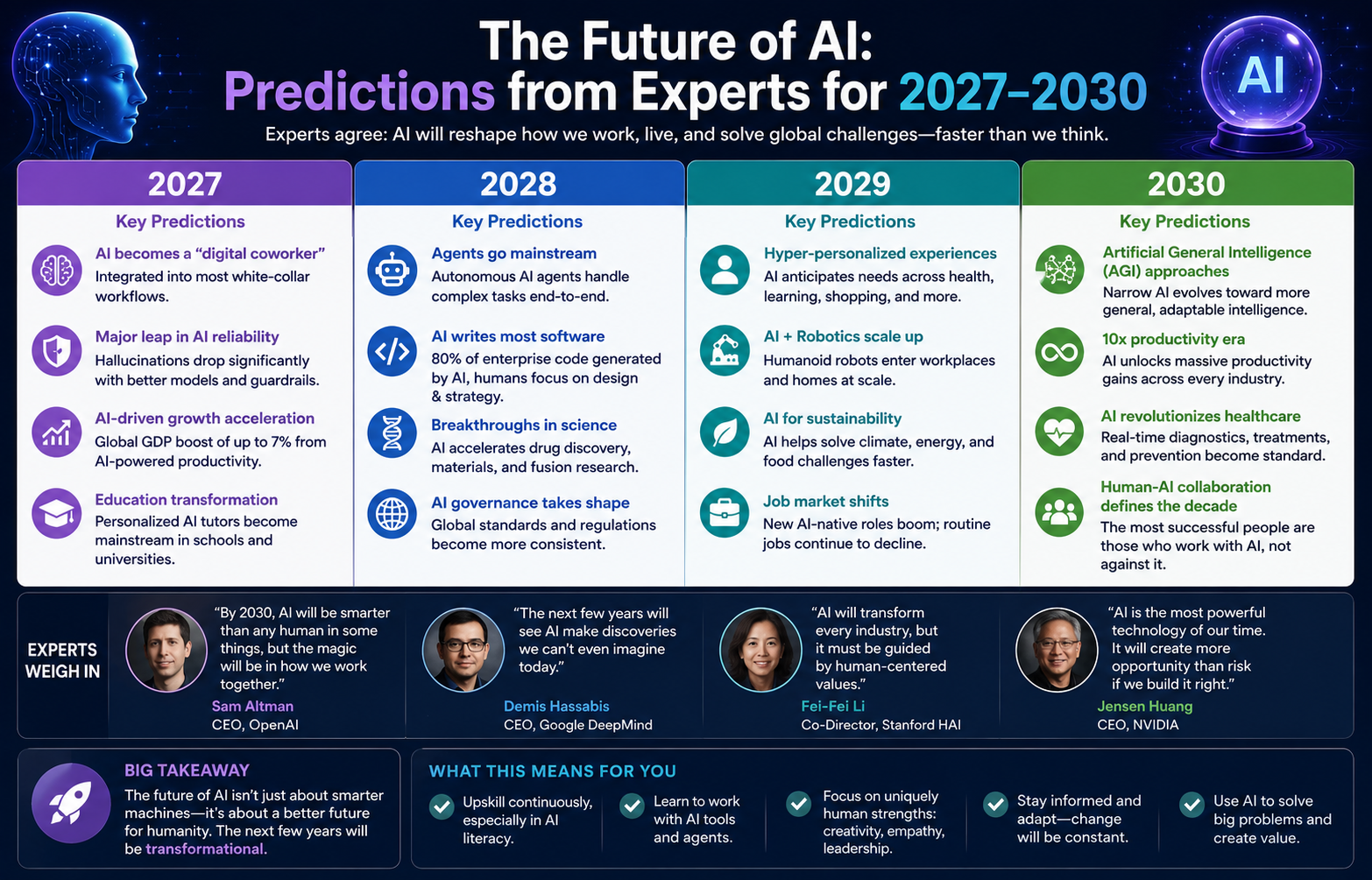
For the past few years, artificial intelligence has felt like a hyper-speed train. We moved from simple text predictive models to autonomous digital agents operating inside enterprise ecosystems within what felt like the blink of an eye.
If the mid-2020s were characterized by the initial shock and adaptation to generative software, the period between 2027 and 2030 will be defined by something far deeper: structural realization.
We are moving past the early hype phase into an era where artificial intelligence fundamentally reshapes global economic output, energy grid infrastructure, software engineering methodologies, and physical scientific discovery. Based on technical forecasts, compute scaling trajectories, and macroeconomic research, here is an in-depth analysis of how AI will transform civilization in the final years of the decade.
1. The Era of the Recursive Feedback Loop (2027–2028)
Currently, human software engineers and AI research teams remain the primary bottlenecks for AI progress. Humans write the underlying code architectures, curate fine-tuning datasets, debug edge cases, and design next-generation GPU cluster topologies.
By 2027, frontier AI research labs are projected to reach a critical inflection point: the complete automation of AI research and development (R&D).
  Traditional Dev Loop: Human Engineer ──> Writes Code ──> Tests Model ──> Slow Iteration

  Recursive AI Loop:   AI Research Agent ──> Refines Architecture ──> Self-Compiles ──> Exponential Scaling
The Compounding Velocity Theory
Once an AI system becomes capable of analyzing its own weights, optimizing its CUDA kernels, and engineering new model architectures without human delay, development cycles cease to be linear—they become exponential.
A specialized AI R&D cluster will theoretically be capable of executing a full year’s worth of algorithmic testing, architectural optimization, and synthetic dataset generation over a single weekend.
This transition to automated self-improvement is expected to drive a massive expansion in reasoning capability between 2027 and 2028, closing the remaining gaps between specialized digital assistants and true Artificial General Intelligence (AGI).
2. From “Stumbling Assistants” to Autonomous Corporate Swarms
The AI applications of 2025 and 2026 are best described as stumbling agents. While capable of handling single-variable tasks—like parsing a document, searching the web, or generating initial code blocks—they remain relatively brittle, requiring human intervention whenever unexpected errors occur.
By 2028, enterprise work environments will shift heavily toward human-led, agent-operated swarms.
Instead of an employee personally managing individual software tools, a single human “Enterprise Architect” will direct multi-agent hierarchies. Specialized agents will communicate using high-speed, machine-native data protocols to execute end-to-end operational workflows:
-
Marketing Agents monitor market sentiment and adjust campaign budgets dynamically in real time.
-
DevOps Agents identify server bottlenecks, patch security vulnerabilities, and push infrastructure updates autonomously.
-
Supply Chain Agents negotiate freight terms, re-route deliveries, and adjust inventory levels based on predictive weather and economic data.
The Operational Shift: The core human skill shifts from executing tasks to defining objectives, setting boundary conditions, and managing system guardrails.
3. The Industrial Grid Shock and the Rise of Green Data Hubs
We cannot talk about the software of 2030 without addressing the massive physical compute infrastructure and raw electrical power required to sustain it. The compute density needed to train multi-trillion parameter models and run real-time multi-agent swarms is pushing global energy grids to physical capacity limits.
Energy research teams at Schneider Electric and major financial institutions project that AI data processing could command between 15% and 20% of total electrical power usage in advanced economies by 2030.
The Infrastructure Pivot
The late 2020s will spark an unprecedented capital expenditure boom toward dedicated energy solutions for compute clusters:
-
Nuclear & Geothermal Co-location: Major technology hyperscalers are directly contracting or acquiring small modular reactor (SMR) nuclear capacity and deep geothermal plants to feed hyper-scale data hubs off-grid.
-
Edge AI Processing: To relieve network bandwidth and data center power draw, inferencing will shift heavily toward localized, high-efficiency Neural Processing Units (NPUs) built into laptops, mobile hardware, industrial machinery, and vehicles.
4. Bio-AI and Breakthroughs in Physical Science
While public attention remains focused on office automation and generative media, the most profound societal impact of AI between 2027 and 2030 will occur in the physical sciences—specifically biotechnology, material science, and clean energy storage.
Moving far beyond early protein-folding predictions, advanced AI simulators will actively synthesize entirely novel, de novo proteins tailored to specific biological targets. This will compress drug discovery timelines from a decade down to a matter of months.
Material Science Acceleration
In material engineering, AI systems will evaluate millions of candidate atomic structures to discover:
-
Solid-State Battery Chemistries: Dramatically increasing energy density for electric vehicles and grid storage.
-
Carbon-Capture Polymers: Novel synthetic materials capable of extracting carbon dioxide from ambient air at industrial scale with low energy requirements.
-
High-Efficiency Semiconductors: Synthetic substrates that reduce heat dissipation in high-density computing clusters.
5. Macroeconomic Outlook & Structural Realignment (2027–2030)
The shift into an agentic economy will generate significant divergence across global markets. Organizations that successfully integrate autonomous multi-agent systems will experience historic capital efficiency, while legacy business models reliant on manual knowledge processing will face severe margin pressures.
| Timeline Horizon | Dominant Technological Trend | Macroeconomic & Workforce Impact |
| 2027 | Recursive AI Self-Improvement | Software development costs drop dramatically; explosive growth in micro-SaaS and lean enterprise startups. |
| 2028 | Edge AI & Grid Integration | Massive capital investments in clean energy infrastructure; grid distribution becomes a primary tech constraint. |
| 2029 | Autonomous Agent Swarms | Structural restructuring across back-office operations, corporate logistics, customer support, and legal operations. |
| 2030 | AI-Driven Scientific Synthesis | First waves of fully AI-designed therapeutics enter clinical trials; new material discoveries reach mass production. |
Key Takeaways: Preparing for the 2030 Landscape
-
Shift from Execution to System Architecture: Future-proof careers will depend on system design, domain expertise, strategic decision-making, and high-level goal formulation rather than procedural task execution.
-
Energy is the New Bottleneck: The primary constraint on artificial intelligence will shift from algorithmic breakthroughs to physical power availability, electrical grid capacity, and semiconductor manufacturing.
-
Physical Science is the Ultimate Frontier: The most valuable breakthroughs of the late 2020s will manifest not just on screens, but in medicine, energy storage, and physical materials.
The period between 2027 and 2030 will not simply be about building faster software—it will be the era where AI integrates deeply into the physical, energy, and economic infrastructure of human civilization.