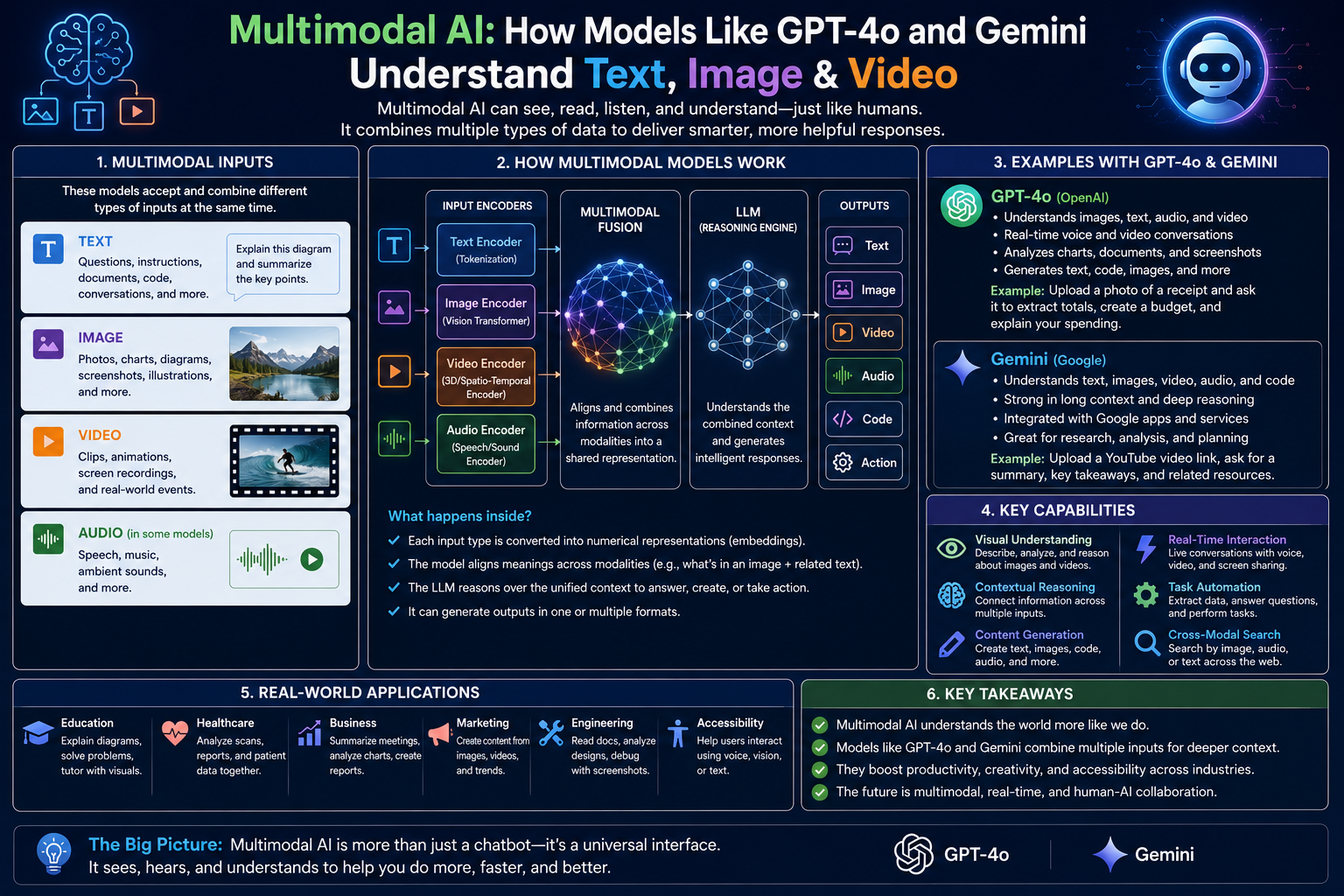
Artificial Intelligence is no longer confined to the written word. In 2026, the most powerful AI models have moved far beyond plain text interfaces—they can see, hear, analyze, and reason across multiple types of data simultaneously. This capability is known as Multimodal AI.
Instead of relying on separate, disconnected tools to transcribe audio, analyze images, or read text, modern multimodal architectures unify these streams into a single system. Whether you upload a photo of a complex circuit board, feed an entire recorded video lecture into a prompt, or speak directly to an assistant with natural voice tones, multimodal models process all these inputs in real time.
This guide breaks down what multimodal AI is, how the underlying technology works, why it represents a massive evolution in artificial intelligence, and how it is being applied today.
Unimodal vs. Multimodal AI: What Changed?
To understand why multimodal systems are such a major leap forward, it helps to compare them with earlier generations of AI:
| Feature | Unimodal AI (Traditional) | Multimodal AI (2026 Standard) |
| Supported Inputs | Single data type (text-only or image-only) | Interleaved text, images, audio, and video |
| Architecture | Separate chained models (e.g., Speech-to-Text $\rightarrow$ LLM $\rightarrow$ Text-to-Speech) | Unified single-stream Transformer architecture |
| Contextual Awareness | Relies solely on text descriptions | Grounded in spatial, visual, and auditory real-world context |
| Latency | Slow due to pipeline handoffs between sub-models | Native real-time interaction with minimal processing delay |
| Error Risk | High error propagation from pipeline handoffs | Low; cross-verifies evidence across visual and textual data |
Key Difference: Traditional AI processed the world through a single narrow filter (like reading a description of a painting). Multimodal AI experiences the world more like humans do—combining sight, sound, and language at the same time.
How Multimodal AI Works Under the Hood
Older systems achieved pseudo-multimodality by stitching together separate specialist tools—using an optical character recognition (OCR) engine to read text from an image, feeding that text into a language model, and sending the output to a voice synthesizer.
Modern multimodal models (such as OpenAI’s GPT-4o or Google’s Gemini 2.5/3.5) use a Unified Transformer Architecture. They process all modalities inside a single, shared neural network backbone.
  Text Input   ──┐
  Image Patches ──┼──> Unified Tokenizer ──> Shared Transformer Backbone ──> Multimodal Output
  Audio Wave   ──┤
  Video Frames ──┘
The Multimodal Processing Pipeline
Leading Multimodal Models in 2026
The competition among frontier AI labs has driven rapid advancements in multimodal reasoning:
-
OpenAI (GPT-4o & GPT-5 Series): Designed from the ground up as a native “omni” model. It handles conversational voice interaction with human-like latency, emotional cadence, and real-time vision capabilities.
-
Google (Gemini 2.5 / 3.5 Pro): Industry leader in massive context windows (up to 1 to 2 million tokens). Gemini excels at processing hours of raw video, analyzing entire code repositories alongside architectural diagrams, and conducting deep research across massive source libraries.
-
Anthropic (Claude 4 / Opus): Exceptional at structured visual analysis—extracting complex tabular data from dense PDF documents, evaluating handwritten technical equations, and identifying subtle flaws in UI/UX wireframes.
-
Open-Weight Ecosystem (Meta Llama 4 Scout / GLM Series): Brings native multimodal capabilities to open-source models, allowing developers to self-host visual and text reasoning models on local hardware.
Practical Real-World Applications
Multimodal AI has moved beyond simple novelty and is driving concrete productivity gains across industries:
1. Advanced Technical & Academic Support
Instead of laboriously typing out complex math formulas or technical bug reports, users can simply snap a photo or take a screenshot. The AI parses the visual elements, identifies structural errors, and explains solutions step-by-step.
2. Automated Video Summarization & Knowledge Extraction
With models capable of ingesting entire video files, professionals can upload recorded webinars, court proceedings, or product demos and ask specific questions like: “At what timestamp does the speaker introduce the Q3 budget updates, and what key metrics are displayed on screen?”
3. Healthcare & Diagnostic Assistance
Medical professionals use multimodal models as secondary diagnostic assistants—comparing patient history text alongside MRI scans, X-rays, and lab results to identify anomalies and suggest differential diagnoses.
4. Hardware Maintenance & Field Work
Field technicians can point a mobile camera at machinery or wiring assemblies. The AI analyzes the live video stream, identifies faulty wiring, and overlays step-by-step repair instructions directly onto the screen.
5. Universal Accessibility
Multimodal models serve as real-time visual interpreters for visually impaired individuals—describing environments, reading signages in foreign languages, and identifying objects through wearable cameras or smartphones.
Current Challenges and Considerations
While multimodal models offer immense capability, users must remain mindful of key limitations:
-
Visual Hallucinations: AI can occasionally misinterpret spatial relationships, misread small text inside dense diagrams, or invent details in complex images.
-
Privacy & Data Security: Uploading images, personal documents, and audio recordings raises significant data governance concerns, particularly in enterprise environments.
-
Computational Footprint: Processing high-resolution video streams and high-frequency audio requires substantially more computing power and bandwidth than standard text queries.
The Path Ahead
As we move through 2026 and toward 2027, multimodal AI is becoming the baseline standard for artificial intelligence. Future developments focus on:
-
Spatial & 3D Understanding: Moving beyond 2D images and flat video frames to full spatial awareness for robotics and spatial computing.
-
On-Device Efficiency: Quantized multimodal models running directly on smartphones and laptops without requiring cloud server processing.
-
Continuous Real-Time Perception: AI agents that can continuously observe video and audio feeds in the background to provide proactive assistance.
Understanding how to combine text, image, and video inputs will remain one of the most effective ways to unlock the full potential of modern AI tools.