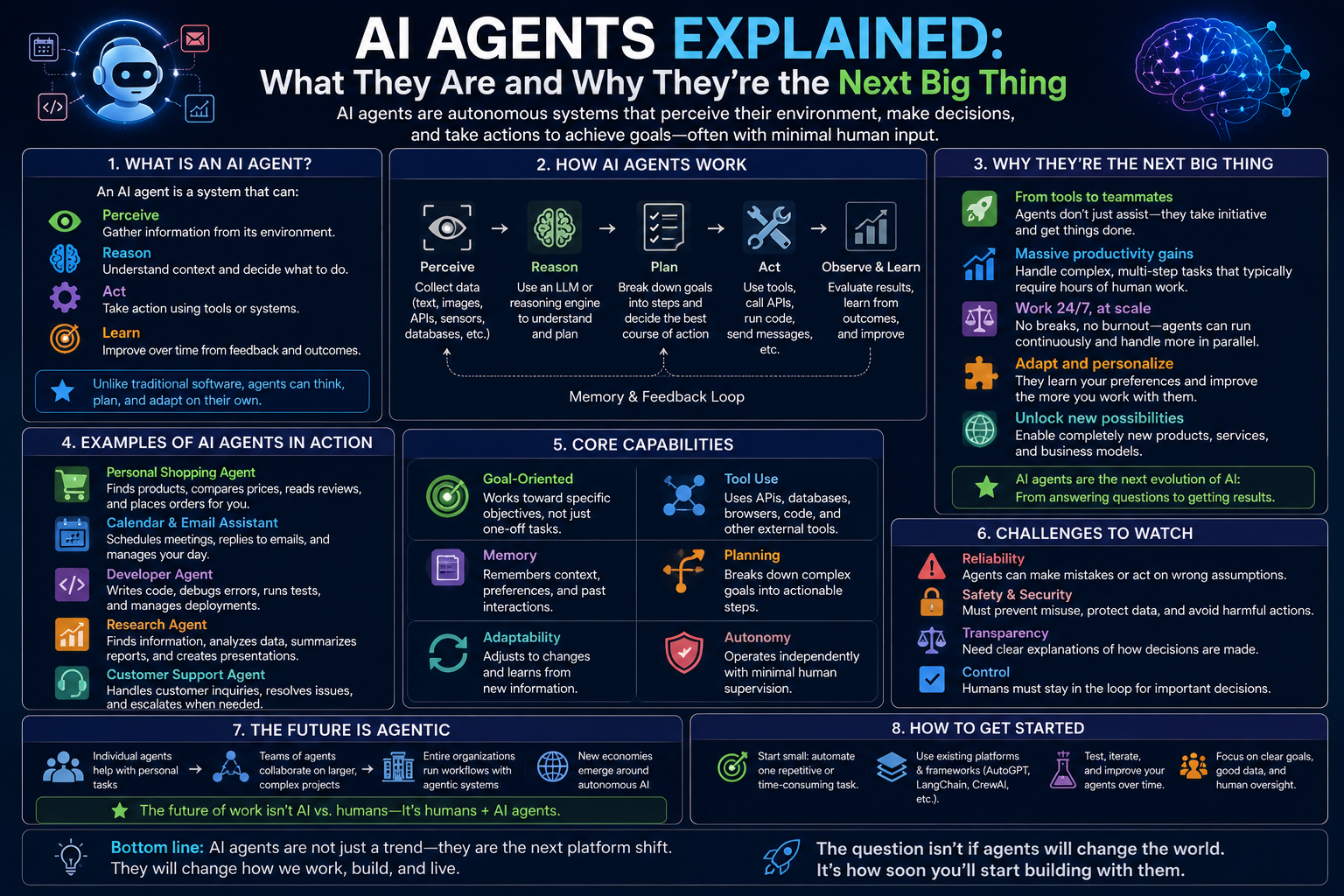
AI Agents in 2026: From Chatbots to Autonomous Digital Colleagues
If you’ve been following artificial intelligence developments in 2026, you’ve likely noticed the term “AI Agents” (or Agentic AI) everywhere. Tech leaders, software developers, and enterprise investors are calling AI Agents the single most transformative shift in technology since the launch of ChatGPT.
But what exactly are AI Agents? How do they differ from traditional chatbots like ChatGPT, Claude, or Gemini? And why are they reshaping how we work and build businesses?
This guide breaks down the world of AI Agents in plain language—no technical background required.

What Is an AI Agent?
An AI Agent is an autonomous software system capable of planning, making decisions, and executing multi-step tasks on your behalf with minimal human supervision.
To understand the leap forward, consider how AI has evolved:
-
Traditional AI (Chatbots): A smart Q&A assistant. You give it a prompt, and it responds with text. It waits passively for your next command.
-
AI Copilots: A helpful assistant working alongside you. It offers inline suggestions (like drafting code or completing a paragraph), but you execute the actions.
-
AI Agents: An autonomous digital worker. You give it a high-level goal, and it breaks that goal down into sub-tasks, chooses the right tools, executes the steps, corrects its own errors, and delivers the finished result.
  Traditional Chatbot:  Human Prompt ──> AI Answer ──> Human Prompt ──> AI Answer

  Autonomous AI Agent: Human Goal ──> [ Plan ──> Use Tools ──> Observe ──> Adapt ] ──> Finished Result
A Real-World Example
Imagine telling an assistant: “Plan and book my business trip to London next month under $1,500.”
-
A Chatbot gives you a generic checklist of websites to visit or a sample list of airlines.
-
An AI Agent checks your Google Calendar for free dates, searches live flight databases via APIs, filters hotels within company policy, selects the best option, presents a final itinerary for approval, and handles the booking.
Chatbots vs. Copilots vs. AI Agents: The Comparison
| Feature | Level 1: AI Chatbot | Level 2: AI Copilot | Level 3: Autonomous AI Agent |
| Primary Goal | Answer questions & write text | Assist with inline suggestions | Complete end-to-end tasks autonomously |
| Operating Style | Reactive (Waits for input) | Collaborative (Guided by human) | Proactive (Self-directed execution) |
| Tool Integration | Limited to basic web search | Specific app add-ons | Full system APIs, databases, & UI control |
| Workflow Scope | Single-turn response | Real-time assistance | Multi-day complex operations |
| Human Supervision | High (Human prompts every step) | Medium (Human executes actions) | Low (Human provides goal & final review) |
How AI Agents Work Under the Hood
The Fundamental Shift: Chatbots talk; AI Agents act. An agent doesn’t just write a workout plan—it syncs with your fitness tracker, orders your meal prep, and reschedules your morning calendar when you miss a workout.
An AI Agent operates through five core interconnected systems:
-
The Core Brain (Large Language Model): Powers reasoning, natural language understanding, and decision-making.
-
Memory Systems: Stores short-term session context and long-term user preferences, enabling the agent to learn from past actions.
-
Planning & Reasoning Engine: Deconstructs complex objectives into logical, sequential sub-goals.
-
Tool Access & Protocols: Connects to external software, databases, web browsers, and APIs using standardized protocols like the Model Context Protocol (MCP).
-
Self-Correction Feedback Loop: Evaluates tool outputs. If an action fails (e.g., a web page fails to load or an API returns an error), the agent analyzes the failure and adjusts its strategy without crashing.
How an AI Agent Executes a Goal

Types of AI Agents in 2026
1. Single-Purpose Task Agents
Specialized agents designed to perform one specific job exceptionally well—such as automated research agents that synthesize academic literature or coding agents that debug software functions.
2. Multi-Agent Systems (MAS)
Instead of relying on a single AI model, Multi-Agent Systems deploy specialized teams of agents that collaborate. For example, in content creation:
-
Agent A acts as the researcher.
-
Agent B writes the initial draft.
-
Agent C acts as an editor, checking for factual accuracy and tone.
3. Autonomous Enterprise Agents
Integrated directly into business software (CRMs, ERPs, DevOps pipelines), these agents run continuously behind the scenes. They triage incoming customer tickets, update inventory databases, and initiate supply chain re-orders automatically.
4. Personal Lifestyle Agents
Hyper-personalized assistants that understand your habits, schedules, and preferences. They manage your daily schedule, track expenses, handle customer support calls, and automate routine administrative tasks.
Real-World Applications in 2026
-
Software Engineering: AI coding agents build full features, run automated unit tests, resolve security vulnerabilities, and submit pull requests.
-
Customer Support: Enterprise support agents resolve multi-step queries—such as processing product returns or issuing store credit—by directly interacting with backend databases.
-
Marketing & Sales: Autonomous teams handle lead qualification, conduct personalized outreach, and optimize ad spend in real time.
-
Operations & Supply Chain: Agents monitor inventory levels, predict supply bottlenecks, and issue purchase orders without manual intervention.
Benefits vs. Real-World Challenges
Key Advantages
-
Massive Time Savings: Converts hours of manual web navigation, data entry, and tab-switching into automated background execution.
-
24/7 Operations: Autonomous systems work continuously, processing tasks around the clock.
-
Lower Operational Friction: Small teams can execute cross-functional workflows that previously required larger headcount allocations.
Challenges & Risk Management
-
Reliability & Hallucinations: Unsupervised agents can occasionally execute wrong API calls or hallucinate data.
-
Security & Permission Control: Granting AI agents direct write-access to financial or company databases introduces security risks if permissions aren’t properly configured.
-
Human Oversight (Human-in-the-Loop): Critical financial, legal, or high-risk decisions still require human approval checkpoints to ensure compliance and accountability.
How to Prepare for the Agentic Era Today
-
Shift to Goal-Based Prompting: Practice defining clear outcomes, boundaries, and constraints rather than asking step-by-step questions.
-
Experiment with Agent Frameworks: Explore agent tools within modern platforms (such as OpenAI Custom GPTs, Claude Projects, or frameworks like LangGraph and CrewAI).
-
Map Out Your Multi-Step Workflows: Identify repetitive tasks in your day that involve moving data between two or three different apps.
-
Implement Governance & Safeguards: Always apply the principle of “least privilege”—give agents read access first, and require human confirmation for sensitive or transactional actions.
Summary
The transition from AI Chatbots to AI Agents represents a fundamental leap in productivity. We are moving from software that simply answers questions to autonomous digital colleagues that get work done. Embracing these tools early gives individuals and organizations a decisive edge in the years ahead.