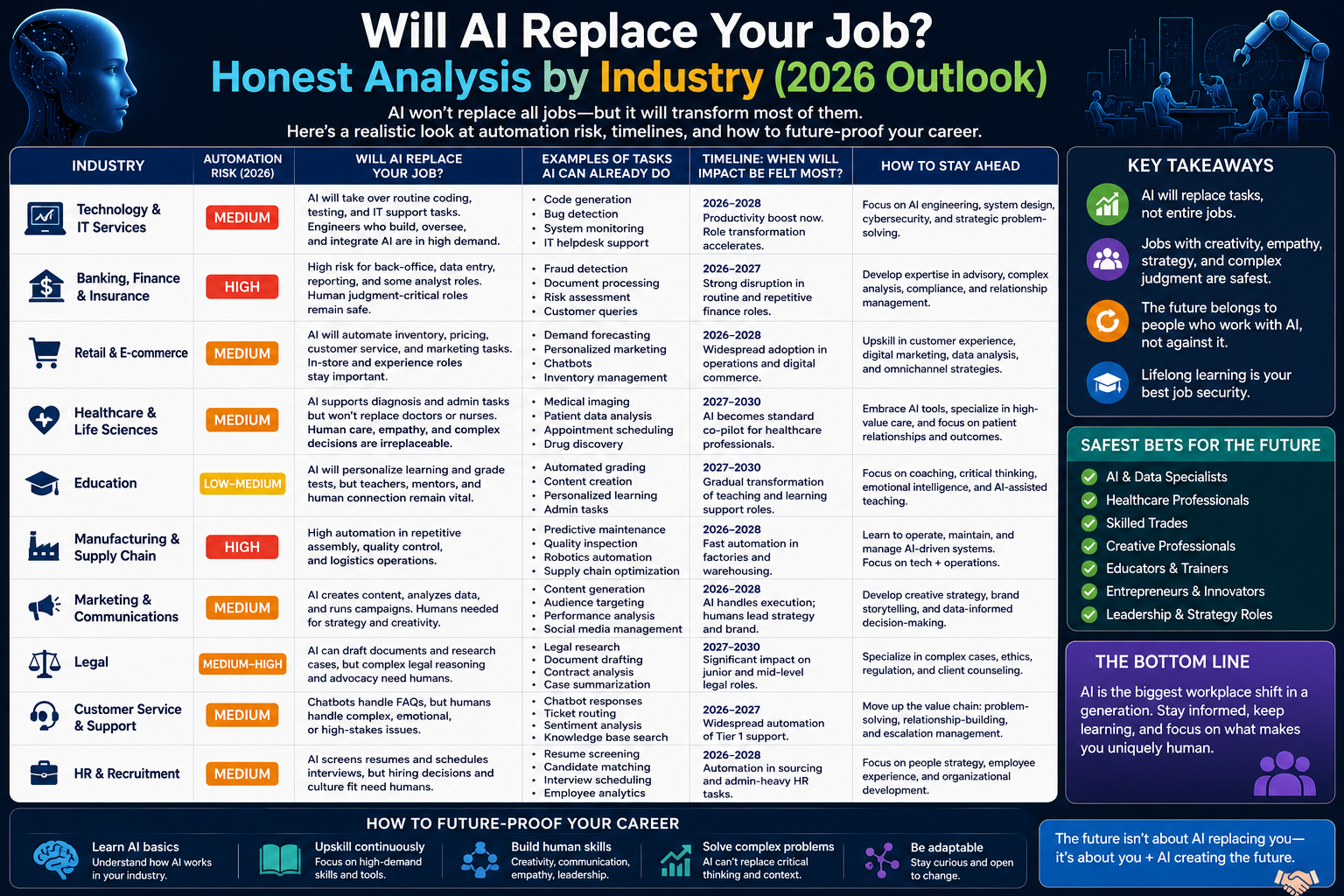
It’s one of the most common fears in 2026: Will AI take my job?
With rapid advancements in AI tools like GPT-4o, Claude, Grok, Gemini, and autonomous agents, this question is on the minds of millions of workers across the globe. Some experts warn of massive job losses, while others claim AI will create more opportunities than it destroys.
The truth, as usual, lies somewhere in the middle.
In this honest 2026 analysis, we’ll examine which jobs and industries are most at risk, which are relatively safe, and how AI is actually transforming work rather than simply replacing it.
Disclaimer: This is not career advice. The job market is complex and constantly evolving. AI capabilities change quickly, and individual outcomes depend on many factors.
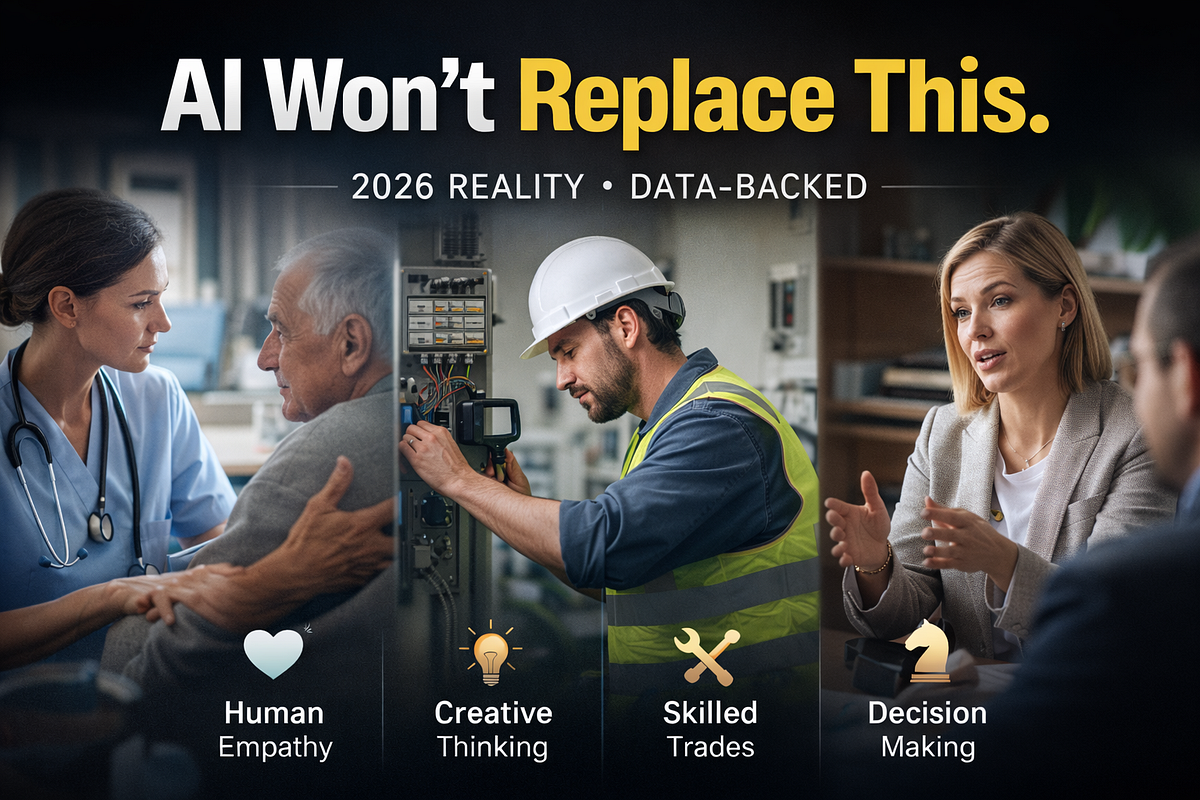
The Reality: Augmentation vs Replacement
Most experts now agree on this important distinction:
- Replacement → AI completely takes over a job.
- Augmentation → AI helps humans do the job faster, better, or at larger scale.
In 2026, augmentation is far more common than full replacement. However, some roles are being heavily disrupted or automated.
Industry-by-Industry Outlook (2026)
1. Customer Service & Support
Risk Level: High for entry-level roles AI chatbots and voice agents now handle 60-70% of routine inquiries in many companies. However, complex problem-solving, empathy-driven situations, and high-value clients still require humans. Future: Many companies are moving to “AI + Human” hybrid models.
2. Content Creation & Marketing
Risk Level: Medium-High AI excels at generating first drafts, social media posts, basic articles, and images. However, strategy, brand voice, emotional storytelling, and original creative thinking remain human strengths. Winners: Writers and marketers who use AI as a powerful assistant.
3. Software Development & Programming
Risk Level: Medium AI coding assistants (like Cursor, GitHub Copilot, and Claude) can write significant amounts of code. However, system architecture, complex debugging, security, and understanding business requirements still need experienced developers. Outlook: Junior coding roles are shrinking, but demand for senior engineers remains strong.
4. Healthcare
Risk Level: Low to Medium AI is excellent at analyzing medical images, suggesting diagnoses, and administrative tasks. However, empathy, ethical decisions, surgery, and patient relationships require human doctors and nurses. Biggest Impact: Administrative and diagnostic support roles.
5. Legal Industry
Risk Level: Medium AI is transforming document review, contract analysis, and basic legal research. Complex negotiation, courtroom strategy, and ethical judgment still need human lawyers. Future: Paralegals doing routine work face the highest risk.
6. Education
Risk Level: Low-Medium AI tutors and personalized learning tools are growing rapidly. However, mentorship, emotional support, classroom management, and motivation still require human teachers.
7. Finance & Accounting
Risk Level: Medium-High Routine bookkeeping, basic financial analysis, and report generation are increasingly automated. Complex financial strategy, regulatory compliance, and client relationships remain human domains.
8. Creative Fields (Design, Art, Music)
Risk Level: Medium AI image and music generators are extremely powerful. However, original concepts, cultural context, brand strategy, and emotional resonance still favor humans. Many creatives now use AI as a collaborative tool.
9. Transportation & Logistics
Risk Level: High for driving roles Autonomous vehicles are advancing, but full adoption in complex environments is slower than expected. Warehouse automation and logistics optimization are growing fast.
10. Manual Trades & Skilled Labor
Risk Level: Low Plumbing, electrical work, construction, and specialized trades are surprisingly safe for now. AI and robotics still struggle with unpredictable physical environments.
Jobs Least Likely to Be Replaced Soon
- Roles requiring high emotional intelligence
- Complex problem-solving in uncertain environments
- Jobs needing physical dexterity in unpredictable settings
- Strategic leadership and decision-making
- Creative direction and original thinking
- Caregiving and healthcare roles needing empathy
Jobs Most at Risk
- Repetitive data entry
- Basic customer support
- Routine content generation
- Simple coding tasks
- Administrative paperwork
- Basic translation and transcription
The New Skill Set for 2026 and Beyond
The winners in the AI era are those who:
- Master AI collaboration (prompt engineering, workflow design)
- Develop strong human skills (empathy, leadership, creativity)
- Combine domain expertise with AI tools
- Continuously learn and adapt
What You Should Do Right Now
- Audit Your Job — Identify which tasks can be automated by AI.
- Learn to Use AI Daily — Make it part of your workflow.
- Build Irreplaceable Skills — Focus on creativity, emotional intelligence, and strategic thinking.
- Stay Updated — Follow AI developments in your industry.
- Consider AI-Proof Niches — Look for roles that benefit from AI rather than compete with it.
Key Takeaways (2026 Outlook)
- AI is transforming jobs more than replacing them in most industries.
- The biggest impact is on routine, repetitive, and predictable tasks.
- Humans who learn to work with AI will have a massive advantage.
- Entirely new jobs are being created around AI management, ethics, training, and integration.
- Adaptation and continuous learning are now essential career skills.
The AI revolution is not something happening to us — it’s something we can actively participate in and benefit from. Those who embrace AI as a powerful collaborator rather than fearing it as a competitor will be best positioned for success in the coming years.
In future posts, we’ll explore specific strategies for AI-proofing your career and the most in-demand skills for the AI economy.
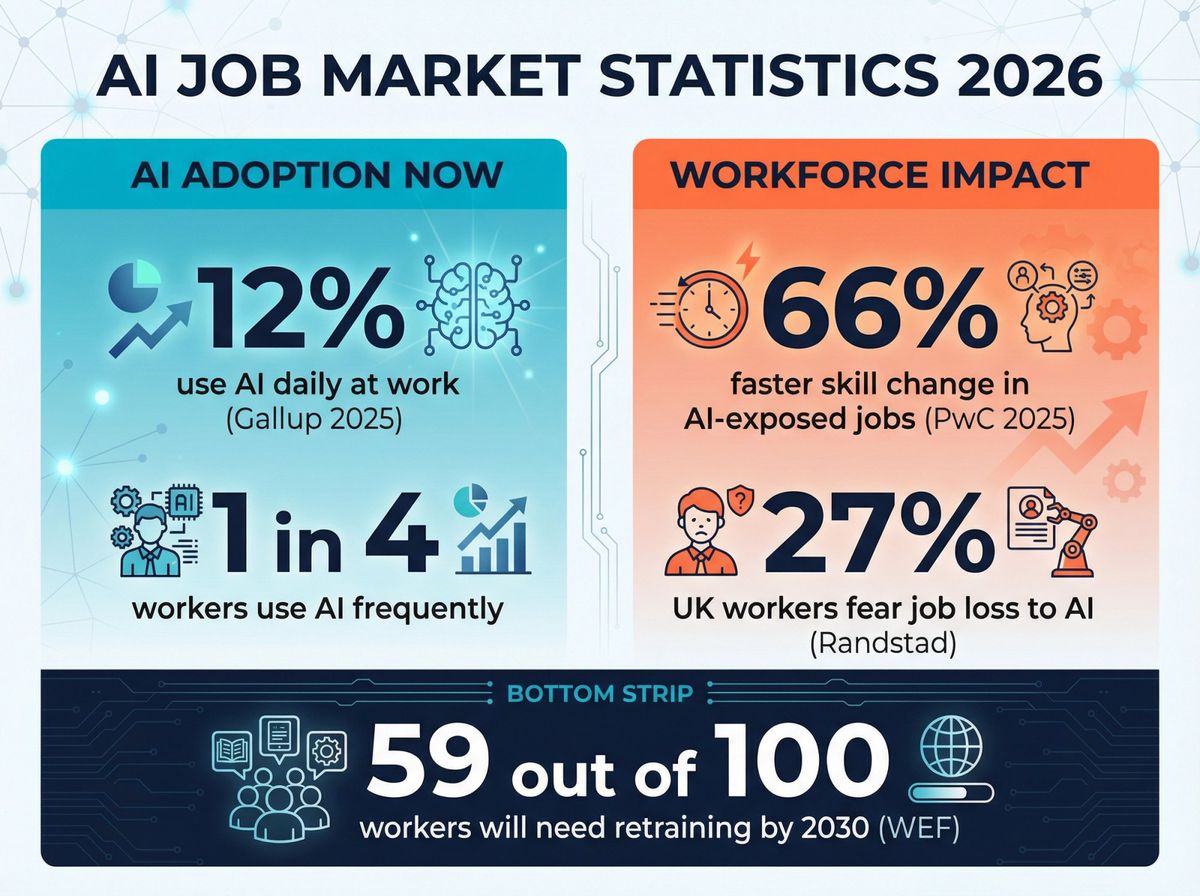
It is one of the most pressing questions across the global workforce: Will AI make my job obsolete?
With the rapid deployment of autonomous AI agents, multimodal models, and advanced coding tools, anxiety about job security is completely understandable. Headlines often bounce between extreme panics of mass unemployment and overly optimistic promises of an effortless future.
The reality unfolding across the job market sits squarely in the middle: AI is fundamentally changing how work gets done, rather than wiping out human labor entirely.
The Macro View: Augmentation vs. Replacement
To understand where your career stands, economists and workforce planners distinguish between two concepts:
-
Replacement (Substitution): AI completely takes over an entire role from start to finish.
-
Augmentation: AI absorbs repetitive, administrative, or routine tasks, allowing humans to work faster, make higher-level decisions, and operate at a larger scale.
According to the World Economic Forum’s Future of Jobs Report, AI and automation are projected to displace roughly 92 million existing roles globally while creating 170 million new roles—resulting in a net gain of 78 million jobs.
  Traditional Role:  [ Routine Tasks (60%) ] + [ Strategic / Human Tasks (40%) ]

  AI-Augmented Role: [ AI Automates Routine ] ──> [ Human Focuses on Strategy & Execution (100%) ]
The 2026 Skill Premium: Workers proficient in AI competencies—such as AI-augmented data analysis, workflow design, and prompt engineering—command an average 56% wage premium over peers in non-augmented roles.
Industry Risk Assessment
The impact of AI varies significantly depending on how much of a job relies on predictable, rules-based tasks versus complex human judgment.
| Industry / Field | Disruption Risk | Primary Impact | Uniquely Human Advantage |
| Customer Support | High (Entry-level) | AI agents resolve 60–80% of routine Tier-1 inquiries. | De-escalating high-tension issues, empathy, and custom relationship building. |
| Software Development | Medium | AI assistants generate boilerplate code and debug errors. | System architecture, complex logic, security compliance, and business alignment. |
| Marketing & Writing | Medium-High | AI handles first drafts, basic copy, and content variation. | Brand strategy, original investigative reporting, emotional resonance, and cultural nuance. |
| Finance & Accounting | Medium-High | Automated bookkeeping, audit reconciliation, and financial report drafting. | High-stakes wealth strategy, risk negotiation, and client trust management. |
| Legal Industry | Medium | Rapid document review, contract analysis, and discovery parsing. | Courtroom advocacy, ethical judgment, and complex client negotiation. |
| Healthcare | Low-Medium | AI assists diagnostic image parsing and administrative notes. | Bedside care, physical surgery, empathy, and complex medical decision-making. |
| Skilled Trades | Low | Minimal physical disruption; AI assists with scheduling and inventory. | Physical adaptability in unpredictable, real-world physical environments. |
Vulnerability vs. Adaptability: What Determines Your Safety?
Rather than asking if your entire industry is safe, look at the individual tasks that fill your workday.
Roles Facing the Greatest Disruption
-
High-Repetition Data Entry & Processing: Administrative paperwork, manual invoice matching, and basic data transcription.
-
Tier-1 Support: Simple, scripted customer support and intake triage.
-
Basic Content Assembly: Summarizing standard documents or writing template-driven articles without original research.
-
Routine Code Maintenance: Standard bug fixes and simple, repetitive component creation.
Roles Most Resilient to Automation
-
Strategic & Visionary Leadership: Navigating ambiguity, setting organizational direction, and making ethical choices under uncertainty.
-
High-Empathy Roles: Caregiving, therapy, executive coaching, and relationship management.
-
Complex Physical Trades: Electrical work, plumbing, specialized carpentry, and emergency repairs.
-
Cross-Disciplinary Innovators: Professionals who sit between domain expertise (e.g., healthcare, law, finance) and technical execution.
Practical Action Plan: How to AI-Proof Your Career
If two-fifths of existing core skills are shifting over the coming years, staying ahead requires intentional adaptation:
-
Audit Your Weekly Tasks: Break down your job into individual activities. Highlight tasks that are repetitive or template-driven, and identify where you can use AI tools to handle them faster.
-
Focus on “AI Complementarity”: Move up the value chain. Instead of competing with AI on speed or volume, focus on judgment, context verification, and strategic synthesis.
-
Build Domain + Technical Fluency: You don’t need a computer science degree. Knowing how to apply AI tools effectively within your specific domain (e.g., legal tech, healthcare operations, financial modeling) makes you far more valuable than a generalist.
-
Strengthen Human-Centric Skills: Communication, emotional intelligence, negotiation, and creative direction are areas where AI models struggle to replicate human nuance.