How AI Actually Works: Neural Networks, Machine Learning & Deep Learning Explained Simply (2026 Edition)
Whether you are chatting with an advanced AI assistant, generating photorealistic images, or relying on autonomous driving features in your car, artificial intelligence is no longer a technology of the future—it is the default engine of modern software in 2026.
Yet, despite using AI every day, most people find the underlying technology mysterious. Terms like Machine Learning, Deep Learning, Neural Networks, Weights, and Backpropagation are often thrown around interchangeably, creating a wall of jargon that obscures how these tools actually function.
In this beginner-friendly guide, we will strip away the hype and complex mathematical equations. By the end of this article, you will understand the exact mechanical framework behind modern AI, how artificial neural networks learn from raw data, and why this technology has advanced so rapidly.
1. The AI Hierarchy: Understanding the Nesting Doll

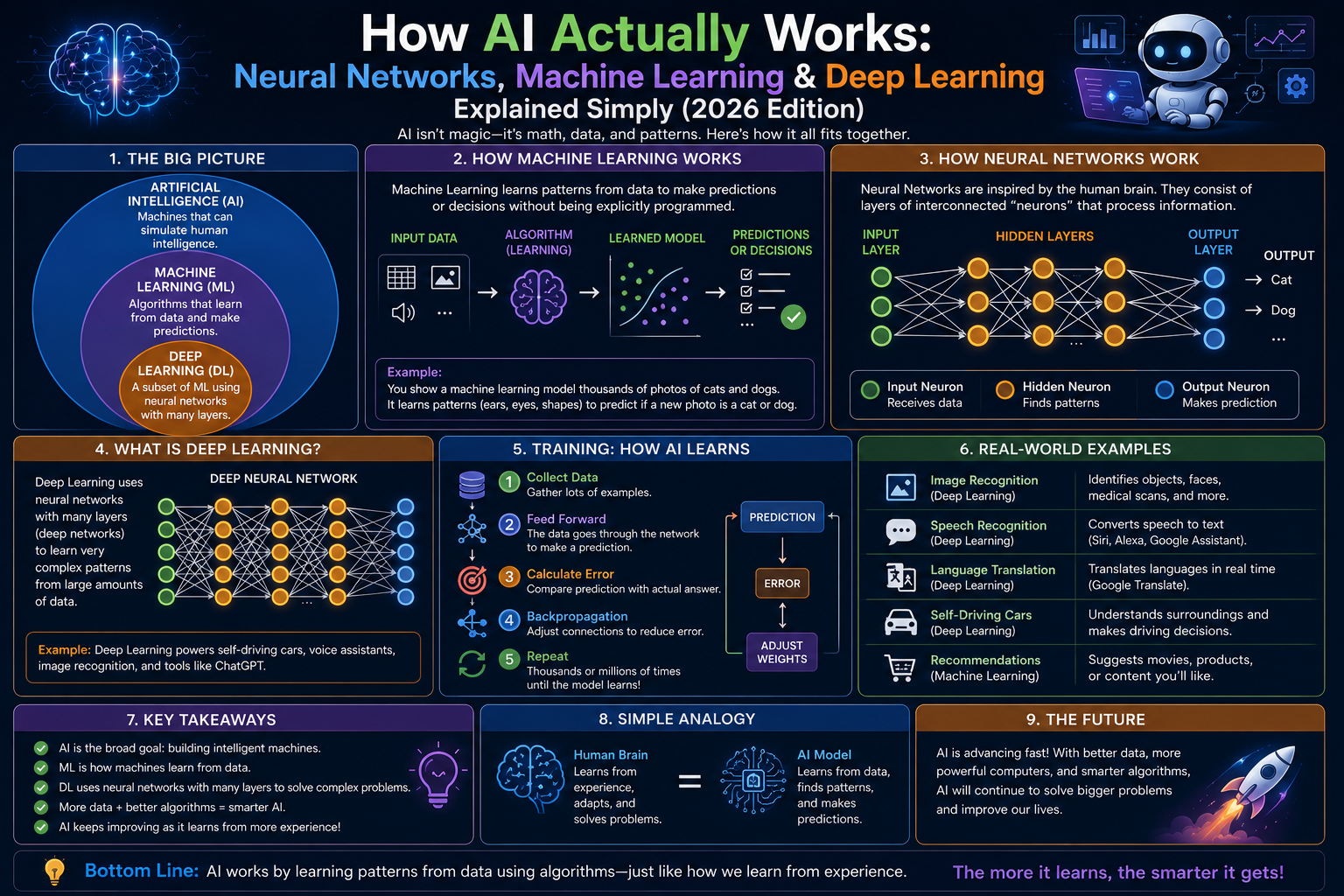
To understand how AI works, you first need to clear up the confusion around three terms that are often used as synonyms: Artificial Intelligence (AI), Machine Learning (ML), and Deep Learning (DL).
They are not competing technologies. Instead, think of them as a set of nested Russian dolls, where each term represents a smaller, more specialized subset of the larger concept.
┌─────────────────────────────────────────────────────────────────────────────┐
│                      THE ARTIFICIAL INTELLIGENCE ECOSYSTEM                  │
├─────────────────────────────────────────────────────────────────────────────┤
│  ARTIFICIAL INTELLIGENCE (Broad field of intelligent systems)              │
│  │                                                                          │
│  └── MACHINE LEARNING (Systems that learn patterns directly from data)      │
│      │                                                                      │
│      └── NEURAL NETWORKS (Models inspired by biological brains)             │
│          │                                                                  │
│          └── DEEP LEARNING (Multi-layered networks learning raw features)   │
└─────────────────────────────────────────────────────────────────────────────┘
The AI-ML-DL Hierarchy Compared
2. The Fundamental Paradigm Shift: Traditional Coding vs. Machine Learning
To grasp how Machine Learning works, consider how traditional software is built compared to how an AI model learns.
Traditional Software Development
For decades, computer programming followed a rigid formula:
-
A human engineer writes Explicit Rules (code).
-
The computer receives Input Data.
-
The computer executes the code and outputs an Answer.
Example: If you want a computer to calculate tax, a programmer writes an explicit formula:
Tax = Income * 0.20. If the income is $50,000, the program outputs $10,000.
The Machine Learning Approach
When dealing with complex real-world problems—like identifying a cat in a photo—traditional coding breaks down. You cannot easily write hardcoded rules for every possible lighting angle, fur pattern, or camera pose.
Machine Learning flips the traditional programming model on its head:
-
You feed the computer Input Data (100,000 photos).
-
You provide the Correct Answers (“Cat” or “Not Cat”).
-
The Machine Learning algorithm analyzes the statistical patterns and Calculates Its Own Rules.
Once those learned rules (called a trained model) are locked in, you can feed it a brand-new photo it has never seen before, and it will accurately predict whether it contains a cat.
3. Anatomy of an Artificial Neural Network
While classical Machine Learning algorithms (like decision trees) work well for structured data like spreadsheets, Deep Learning uses Artificial Neural Networks (ANNs) to process unstructured data like text, images, and audio.
An artificial neural network is loosely inspired by the human brain, which processes information using billions of interconnected biological neurons. In an artificial network, these “neurons” are mathematical nodes organized into three distinct layers.
[ Input Layer ]  ──>  [ Hidden Layer 1 ]  ──>  [ Hidden Layer 2 ]  ──>  [ Output Layer ]
 (Raw Pixels)          (Edges & Lines)         (Shapes & Features)      ("Cat: 96%")
1. The Input Layer
This layer receives raw, unprocessed data converted into numbers.
-
For an image, the inputs are the numerical color values of individual pixels.
-
For text, the inputs are numerical representations of words or sub-words (called tokens).
2. The Hidden Layers (The “Deep” in Deep Learning)
The hidden layers sit between the input and output. A network with just one hidden layer is considered “shallow.” Modern deep learning models stack dozens or even hundreds of hidden layers.
Each hidden layer is responsible for extracting progressively higher levels of abstraction:
-
Early Layers: Recognize simple, low-level features (e.g., vertical lines, color contrast, sharp edges).
-
Middle Layers: Combine those lines into complex shapes (e.g., circles, textures, eye curves).
-
Deep Layers: Combine those shapes into identifiable conceptual entities (e.g., a snout, a whiskered face, a human ear).
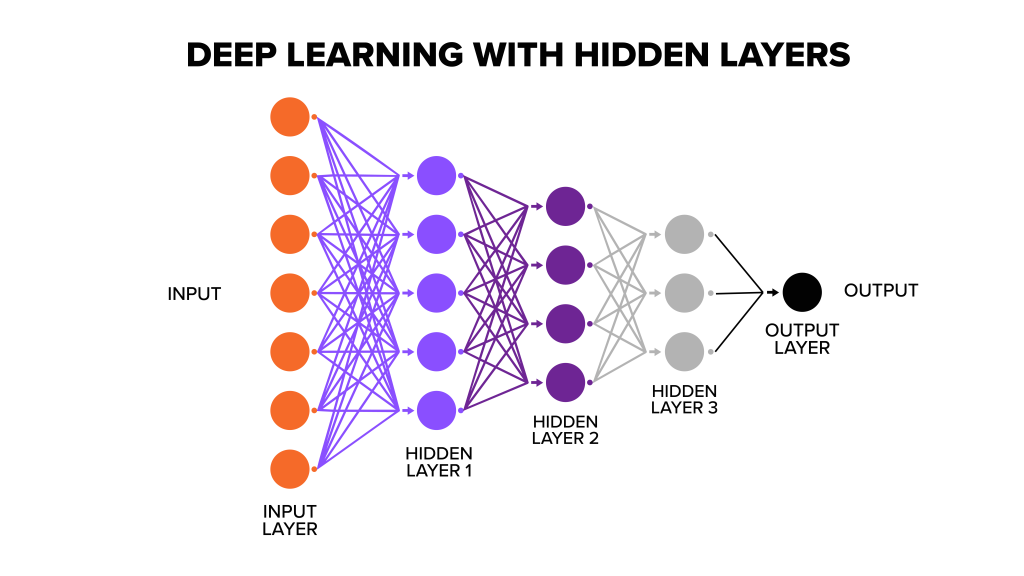
3. The Output Layer
The final layer delivers the network’s prediction. For an image classifier, it might output confidence probabilities across different categories (e.g., 96% Cat, 3% Dog, 1% Car).
4. The Building Block: Inside a Single Artificial Neuron
To understand how data flows through a neural network, let’s zoom in on a single artificial neuron. Every neuron performs a simple four-part calculation:
Inputs (X) ──x──> Weights (W) ──(+)──> Add Bias (B) ──> Activation Function ──> Output
-
Inputs (): Numerical values passed from the previous layer.
-
Weights (): Connection strengths assigned to each input. A higher weight means that specific input has a stronger influence on the neuron’s final decision.
-
Bias (): An added baseline number that acts like a threshold, determining how easily the neuron “fires” regardless of the inputs.
-
Activation Function: A mathematical formula that introduces non-linearity (such as ReLU or Sigmoid). Without activation functions, a neural network—no matter how many layers it has—would just be a basic linear equation incapable of learning complex patterns.
5. How Neural Networks Learn: The 4-Step Training Loop
When a neural network is first created, it knows nothing. Its weights and biases are initialized to completely random numbers. If you feed it a photo of a cat, it might guess “Airplane” with 99% confidence.
Training a neural network is the process of iteratively adjusting millions (or billions) of weights until its guesses become accurate. This happens through a continuous 4-step feedback loop repeated millions of times.
Step 1: The Forward Pass (Making a Prediction)
Data flows forward through the network from the input layer, through the hidden layers, to the output layer. The network calculates a prediction based on its current weights.
Step 2: Calculating the Loss (Measuring the Error)
The network’s guess is compared against the actual correct answer using a Loss Function. The loss function produces a single numerical score representing how far off the prediction was.
-
High Loss: The guess was wildly incorrect.
-
Low Loss: The guess was highly accurate.
Step 3: Backpropagation (Assigning Blame)
Once the error is calculated, the network runs Backpropagation (backward propagation of errors). Working backward from the output layer to the input layer, calculus is used to determine precisely which weights contributed most to the error.
Step 4: Gradient Descent (Adjusting the Weights)
Using an optimization algorithm called Gradient Descent, the system tweaks the network’s weights in the direction that reduces the total loss score.
Analogy: Imagine standing near the peak of a foggy mountain in complete darkness. You want to reach the bottom of the valley (minimum loss). You take a small step in whatever direction slopes downhill most steeply. Repeating this process step-by-step eventually brings you safely to the bottom.
Over millions of training iterations (called epochs), the loss score drops close to zero, and the network becomes highly accurate at its task.
6. Key Neural Network Architectures Driving AI in 2026
While the basic neural network structure applies across deep learning, specialized architectural designs are tailored for different types of data:
-
Transformers: The reigning architecture for language models and multimodal systems. Transformers use a mechanism called Self-Attention to process entire sequences of text or images simultaneously, allowing the model to understand context across vast distances in a document.
-
Convolutional Neural Networks (CNNs): Designed specifically for spatial data like images and video. They slide mathematical filters across pixels to detect visual features invariant to position.
-
State Space Models (SSMs) & Hybrid Networks: Emerging alternatives and companions to Transformers that process ultra-long streams of data (like long-form audio or continuous video) with significantly reduced memory consumption.
-
Diffusion Models: The core architecture behind generative image and video models. They operate by taking pure random noise and iteratively refining it step-by-step until a sharp image matching a text prompt emerges.
7. Frequently Asked Questions (FAQ)
What is the main difference between Machine Learning and Deep Learning?
Classical Machine Learning relies on human experts to manually curate and define the features the model should analyze (feature engineering). Deep Learning automatically extracts and learns those features directly from raw data using multi-layered neural networks.
Does a neural network actually work like a human brain?
While early neural network designs were loosely inspired by biological neurobiology, modern deep learning architectures are purely mathematical optimization engines. They do not possess consciousness, intent, or biological feeling.
What are “Parameters” in an AI model?
Parameters are the sum total of all the weights and biases inside a neural network. When a model is referred to as having “70 Billion Parameters,” it means there are 70 billion individual numerical dials that were tuned during the training process.
Key Takeaways
-
AI is the broad goal; Deep Learning is the engine: Machine learning enables computers to learn from data, while deep learning uses stacked neural networks to process complex unstructured inputs like text, images, and audio.
-
Feature Discovery is Automated: Deep neural networks eliminate manual rule writing by discovering abstract patterns on their own through hierarchical layers.
-
Learning is an Iterative Loop: Neural networks improve through a 4-step process: predicting (Forward Pass), measuring error (Loss), identifying responsible connections (Backpropagation), and adjusting weights (Gradient Descent).
-
Scale and Context Drive Modern AI: Modern generative tools rely on specialized architectures like Transformers and Diffusion models, powered by trillions of data points and massive compute clusters.