The Ultimate Beginner’s Guide to Artificial Intelligence in 2026: Everything You Need to Know
Artificial Intelligence (AI) is no longer a futuristic concept confined to science fiction novels or Hollywood blockbusters. In 2026, AI has quietly woven itself into the fabric of our daily routines.
It powers the search engines that answer our sudden late-night questions, helps physicians spot microscopic tumors on early-stage scans, drafts code for developers, and orchestrates autonomous workflows for businesses around the globe.
Yet, despite its ubiquity, many people still find AI mysterious, intimidating, or confusing. What actually happens behind the scenes when an AI model gives you an answer? Is AI actually “thinking”? And why is this technology evolving faster than almost any other invention in human history?
In this comprehensive, beginner-friendly guide, we will break down artificial intelligence into simple, everyday language. No engineering degree, math background, or programming experience required.
Important Educational Disclaimer: This guide is intended purely for educational and informational purposes. While AI is an extraordinarily transformative technology, it comes with inherent technical limitations, ethical considerations, and practical risks that every user should understand.
1. What Is Artificial Intelligence?
At its most fundamental level, Artificial Intelligence is the branch of computer science dedicated to building machines capable of performing tasks that traditionally require human intelligence.
When humans solve problems, we rely on a combination of visual recognition, language processing, logic, emotional context, and past experience. AI systems attempt to replicate these cognitive outcomes—not necessarily by feeling or thinking like a human, but by processing massive quantities of data to recognize patterns and make decisions.
┌─────────────────────────────────────────────────────────────────────────────┐
│                           CORE CAPABILITIES OF AI                           │
├─────────────────────────────────────────────────────────────────────────────┤
│  [ Natural Language ] ──> Understanding, translating, & writing text        │
│  [ Computer Vision ]  ──> Identifying objects, faces, & motion in video     │
│  [ Problem Solving ]  ──> Reasoning through complex multi-step logic        │
│  [ Pattern Learning ] ──> Improving accuracy over time using data           │
└─────────────────────────────────────────────────────────────────────────────┘
The Three Spectrumes of Artificial Intelligence
To understand where technology stands today—and where it might go in the future—computer scientists categorize AI into three distinct developmental tiers:
| AI Tier | Definition | Current Status (2026) | Real-World Examples |
| Narrow AI (Weak AI) | AI designed and trained to excel at one highly specific task. It cannot perform outside its domain. | Fully Active & Mainstream | Spam filters, Google Translate, Netflix recommendations, chess engines, face unlock. |
| General AI (AGI / Strong AI) | AI with human-level adaptability across any cognitive task, capable of transfer learning and abstract reasoning. | In Active Development | Advanced reasoning models and multi-agent systems are stepping stones, but true AGI remains unrealized. |
| Superintelligence (ASI) | Hypothetical AI that far surpasses human intelligence across all fields, including creativity, wisdom, and social skills. | Theoretical / Speculative | Currently exists only in research theories and science fiction. |
2. A Brief History: How We Arrived at the 2026 AI Era
The rapid explosion of AI over recent years makes it feel like a sudden breakthrough, but the foundation was laid over seven decades ago.
1950s: Foundations ──> 1980s: Expert Systems ──> 2012: Deep Learning ──> 2022–2026: Generative & Agentic AI
The 1950s–1960s: The Foundations
The field was formally birthed in 1956 at the Dartmouth Summer Research Project on Artificial Intelligence. Early pioneers created basic algorithms that could solve simple algebraic word problems, prove logical theorems, and play checkers.
The 1980s–1990s: Expert Systems & Rules-Based Logic
In the 1980s, corporations adopted “Expert Systems”—programs coded with thousands of explicit “if-then” rules written by human specialists. While useful for basic decision trees, these systems were fragile; if presented with a scenario outside their hardcoded rules, they broke down instantly.
The 2012 Breakthrough: The Deep Learning Revolution
Everything changed around 2012. The convergence of three forces—massive internet datasets, powerful graphics processing units (GPUs), and advanced artificial neural network architectures—allowed algorithms to teach themselves patterns directly from raw data rather than relying on human-written rules.
2022–2026: Generative AI, Multimodality, and AI Agents
The public rollout of Large Language Models (LLMs) transformed AI from a behind-the-scenes enterprise tool into a direct consumer interface. By 2026, AI has evolved beyond simple text responses into multimodal engines (capable of processing voice, video, images, and code simultaneously) and autonomous AI agents capable of executing complex workflows independently.
3. How AI Works Behind the Scenes (Without the Math)
To understand modern AI, you don’t need to write code. You only need to understand three interconnected concepts: Machine Learning, Deep Learning, and Training Data.
┌─────────────────────────────────────────────────────────────────────────────┐
│                       THE ARTIFICIAL INTELLIGENCE STACK                     │
├─────────────────────────────────────────────────────────────────────────────┤
│  ARTIFICIAL INTELLIGENCE (Broad field of smart systems)                     │
│  └── MACHINE LEARNING (Systems that learn from data patterns)              │
│      └── DEEP LEARNING (Multi-layered neural networks inspired by brains)   │
│          └── LARGE LANGUAGE MODELS / GENERATIVE AI (Text, Vision, Audio)    │
└─────────────────────────────────────────────────────────────────────────────┘
1. Machine Learning (ML): Learning from Examples
In traditional software engineering, a human programmer writes explicit rules:
Input Data+Rules=Output
In Machine Learning, the process is inverted:
Input Data+Desired Answers=The Computer Figures Out The Rules
For instance, rather than programming 10,000 rules describing what a cat looks like (whiskers, pointed ears, fur color), you feed an ML algorithm 100,000 labeled photos of cats and dogs. The system analyzes the pixel distributions and discovers the statistical patterns that distinguish a cat on its own.
2. Deep Learning & Neural Networks
Deep Learning is a specialized subfield of Machine Learning powered by Artificial Neural Networks. Inspired by the interconnected neurons in the human biological brain, these mathematical networks pass information through multiple processing layers:
-
Input Layer: Receives raw pixels, audio waves, or text tokens.
-
Hidden Layers: Each subsequent layer identifies increasingly complex features. (Layer 1 might detect edges; Layer 2 detects shapes; Layer 3 detects eye structures; Layer 4 identifies a human face).
-
Output Layer: Delivers the final prediction or text generation.
3. The 3-Step AI Training Process
[ Step 1: Ingestion ] ──> [ Step 2: Prediction ] ──> [ Step 3: Parameter Adjustment ]
-
Ingestion: The model is fed colossal training datasets containing trillions of words or billions of images.
-
Prediction: The model attempts to predict the next word in a sentence or identify an object in an image.
-
Adjustment: If the prediction is wrong, the system calculates its error rate and adjusts its internal connections—known as parameters—to refine future guesses. Modern state-of-the-art models adjust hundreds of billions of parameters during this phase.
4. The Core Types of AI Systems in 2026
If you are exploring the landscape today, you will encounter four primary categories of modern AI technology:
1. Generative AI
Generative models do not simply classify existing data—they generate brand-new original content based on statistical likelihoods.
-
Text Generation: Drafting long-form articles, summarizing reports, composing emails.
-
Image & Design: Creating photorealistic imagery, digital artwork, or UI layouts from natural language prompts.
-
Audio & Music: Producing studio-grade voiceover narrations or full musical compositions from text scripts.
-
Video Synthesis: Rendering high-definition video clips complete with natural physics and lighting consistency.
2. Multimodal AI
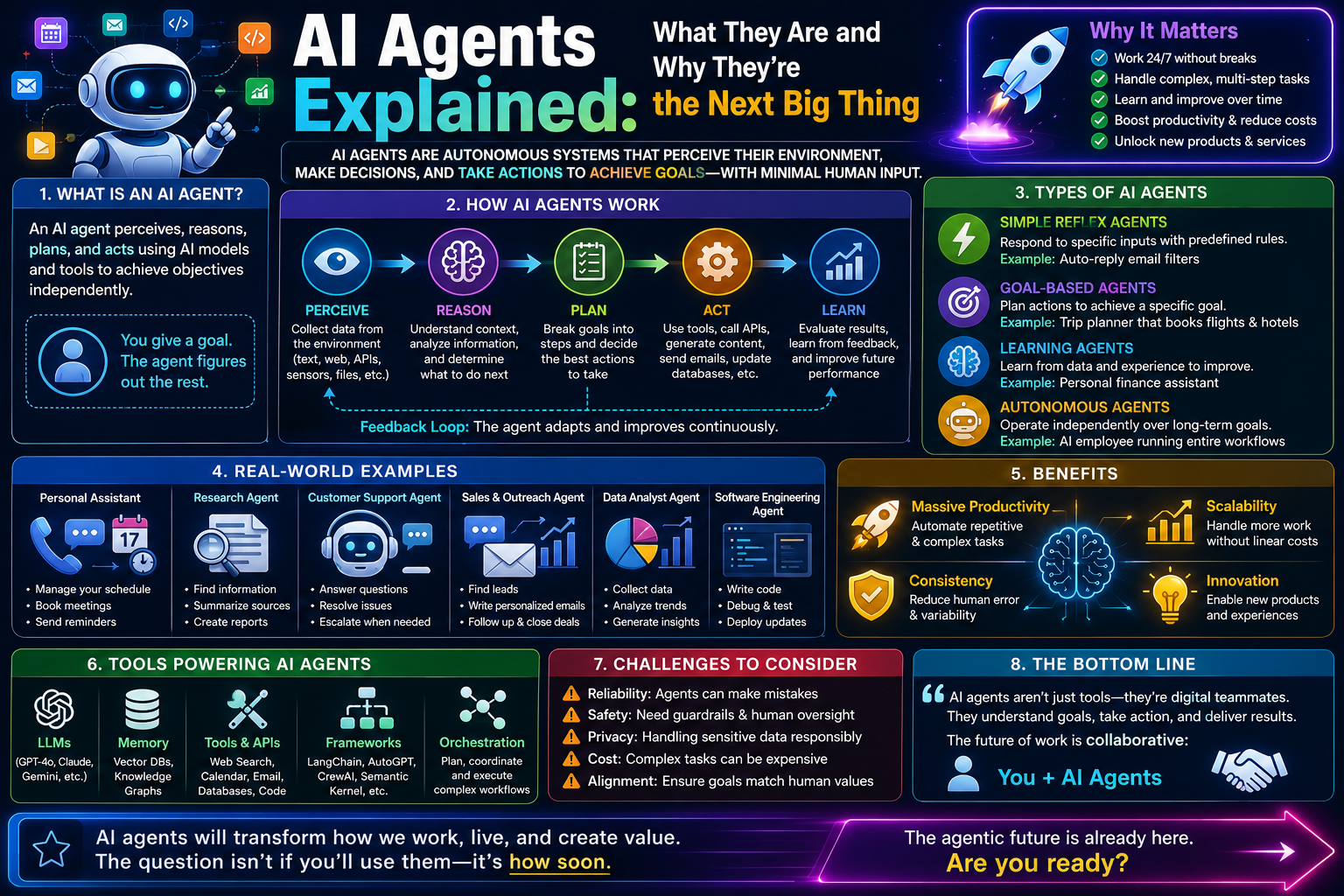
Earlier AI models were limited to a single format (text-only or image-only). Modern multimodal models process multiple sensory streams at the same time. You can show an AI a picture of a broken engine, speak a verbal question aloud, and receive an instant structural analysis in text or voice format.
3. Autonomous AI Agents
AI Agents mark the transition from passive chat assistants to active problem solvers. Instead of simply answering a question, an agent can be assigned a goal:
“Research the top three conference venues in Chicago for 500 attendees, draft an email inquiry to each, and output a pricing comparison table.”
The agent breaks down the task into sub-steps, uses web browsers and APIs autonomously, verifies its own work, and presents the final result.
4. Edge AI & Small Language Models (SLMs)
While giant cloud-based models run inside massive data centers, On-Device AI allows lightweight, highly efficient models to run directly on smartphones, laptops, and automotive chips. This enables instantaneous responses without requiring an internet connection while keeping personal data private.
5. Real-World Applications Across Key Industries
Artificial Intelligence is actively re-architecting fundamental sectors of the global economy in 2026:
Healthcare & Medicine
-
Early Diagnostics: Deep learning vision models detect subtle abnormalities in mammograms, MRIs, and retinal scans long before they become visible to the human eye.
-
Drug Discovery: AI models predict how proteins fold, compressing drug development timelines from years down to months.
-
Personalized Care: Custom algorithms tailor medical treatment plans based on an individual patient’s unique genetic code.
Education & Learning
-
Adaptive AI Tutors: Every student can access a 24/7 personal tutor that adapts explanations to their learning speed, testing knowledge without judgment.
-
Automated Administrative Relief: Teachers leverage AI to grade objective assignments, generate tailored lesson plans, and track student progress metrics.
Software Engineering & IT
-
Co-Pilot Coding: Developers use AI coding assistants to write boilerplate code, spot security vulnerabilities, translate legacy languages, and convert product specifications into functional software.
Business & Finance
-
Fraud Detection: Algorithmic security networks analyze millions of financial transactions per second, freezing fraudulent credit card charges instantly.
-
Customer Operations: Intelligent conversational agents resolve complex billing issues and logistical tracking requests without holding customers on phone queues.
6. The Double-Edged Sword: Benefits vs. Ethical Challenges
While the benefits of artificial intelligence are extraordinary, responsible adoption requires an honest examination of its inherent risks.
┌─────────────────────────────────────────────────────────────────────────────┐
│                          BALANCING THE AI PARADIGM                          │
├─────────────────────────────────────────────────────────────────────────────┤
│  PROS / OPPORTUNITIES                     CONS / RISKS                      │
│  ├─ Exponential Productivity Booster      ├─ Job Displacement & Reskilling  │
│  ├─ Accelerating Scientific Progress       ├─ Algorithmic Bias & Unfairness  │
│  ├─ Democratizing Advanced Tools          ├─ Misinformation & Deepfakes     │
│  └─ 24/7 Precision Operations             └─ Data Privacy & Security Risks  │
└─────────────────────────────────────────────────────────────────────────────┘
Major Ethical Challenges in Focus
1. Algorithmic Bias and Fairness:
AI models learn from historical human data. If the input data contains implicit societal biases regarding gender, race, or socio-economic background, the AI will mirror and amplify those biases in hiring recommendations, loan approvals, or legal sentencing tools.
2. Misinformation and Synthetic Media:
As generative video and audio models reach hyper-realistic fidelity, verifying authentic media becomes increasingly difficult. Deepfakes present serious challenges for elections, journalism, and personal privacy.
3. Job Market Transition:
Automation is shifting from routine physical labor to knowledge work. While AI creates brand-new industries (such as AI safety engineering and prompt architecture), it also displaces traditional roles in data entry, customer support, and basic copy editing.
4. Global Governance and Safety Regulations:
Governments around the world are implementing comprehensive regulatory frameworks—such as the landmark EU AI Act—establishing strict compliance mandates, risk tiers, and transparency obligations for developers deploying high-risk AI models.
7. A Practical Beginner’s Guide: How to Start Using AI Effectively
If you want to harness AI in your daily life or professional career, master the art of Prompt Engineering—the practice of structuring inputs so an AI model gives you clear, high-quality responses.
The 4-Part Prompt Framework
Whenever you interact with a text-based or multimodal AI tool, structure your request using this simple template:
[ Role ] + [ Task ] + [ Context ] + [ Output Format ]
-
Role: Tell the AI who it should act as. (“Act as an expert career advisor…”)
-
Task: State clearly what action it needs to take. (“…rewrite my résumé bullets to highlight leadership skills.”)
-
Context: Give necessary background information. (“I am applying for a mid-level project manager position in the renewable energy sector with 5 years of experience.”)
-
Output Format: Specify how you want the answer delivered. (“Present the response as a bulleted list with before/after comparisons.”)
8. Frequently Asked Questions (FAQs)
Is AI going to replace human workers entirely?
History shows that technological revolutions (like the industrial revolution or the rise of the personal computer) displace specific job functions while creating entirely new job categories. The common consensus in 2026 is that “AI won’t replace you, but a human using AI effectively might.”
Can AI think, feel, or experience consciousness?
No. Modern AI systems—no matter how convincing or articulate—are complex mathematical pattern recognizers. They do not possess feelings, self-awareness, intentions, or true understanding. They generate outputs based on statistical relationships between words, code, and pixels.
What is the difference between ChatGPT, Claude, Gemini, and DeepSeek?
These are competing Large Language Model families built by different AI research companies (OpenAI, Anthropic, Google, and DeepSeek, respectively). While they perform similar core tasks, they differ in technical architectures, speed, context length, coding specialization, reasoning depth, and privacy policies.
Is my personal data safe when I talk to an AI?
It depends on the privacy settings of the platform you use. Most consumer AI services log conversation histories to train future models unless you explicitly opt out in the security settings or use local, privacy-focused offline tools.
The Road Ahead: What’s Next for AI?
We are living through one of the most significant technological shifts in human history. Artificial Intelligence is transitioning from an era of passive chat interfaces into an era of active, reasoned collaboration.
Understanding the fundamentals of AI empowers you to navigate this changing landscape with confidence. Instead of viewing AI as something to fear or blindly embrace, view it for what it truly is: a powerful human amplifier.
Upcoming Deep-Dives in This Series:
-
Mastering Prompt Engineering: Advanced Strategies for Daily Productivity
-
The Best Free & Paid AI Tools You Should Use in 2026
-
How to Run Privacy-Focused Local AI Models on Your Laptop