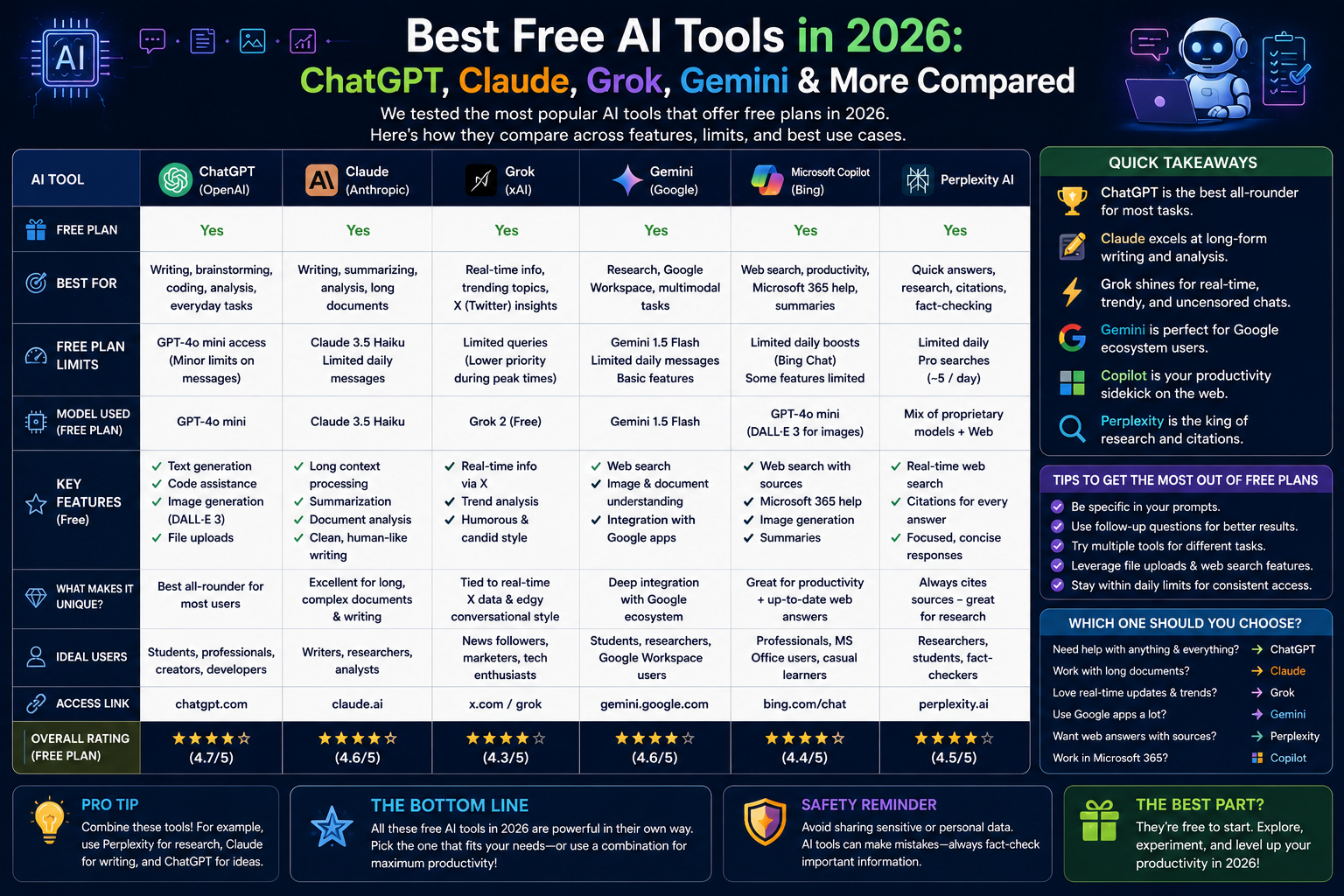
2026 has officially ushered in the era of accessible AI. What once required expensive enterprise subscriptions or specialized technical expertise is now available for free to anyone with a browser.
Whether you’re drafting long-form content, debugging code, synthesizing dense research, or generating creative media, there’s a powerful model ready to assist. But with the market flooded by competing assistants, which platform actually earns a permanent spot in your daily workflow?
After testing these tools across hundreds of real-world projects—from long-form technical writing to rapid coding and market analysis—here is an honest, personal breakdown of the best free AI platforms in 2026, their hidden limitations, and how to combine them for maximum productivity.
2026 Quick Comparison Matrix

Deep-Dive Tool Reviews
1. Claude (Anthropic) — My Top Pick for Deep Work & Nuanced Writing
If your daily tasks involve writing articles, analyzing multi-page documents, or solving tricky logic problems, Claude remains the gold standard in 2026.
-
Why I rely on it: Claude writes like a human peer, not an algorithm. Its ability to follow complex, multi-step instructions without losing the plot halfway through makes it my default choice for long-form drafting and code reviews.
-
The Free Experience: Anthropic offers solid daily access to its core models, though heavy power users will hit message caps during peak hours.
-
Where it falls short: It lacks built-in native image generation and real-time web browsing, so it relies heavily on the text and documents you upload.
Best Used For: Drafting publication-ready content, analyzing complex PDFs, architectural code design, and structural feedback.
2. ChatGPT (OpenAI) — The Undisputed Daily All-Rounder
OpenAI’s ChatGPT remains the most versatile assistant on the web. It bridges the gap between simple text chat, web searching, Python code execution, and image generation within a single conversational thread.
-
Why I rely on it: When I don’t know which tool to start with, I open ChatGPT. Its long-term chat memory means it remembers preferred formatting and past context across separate sessions without constant re-prompting.
-
The Free Experience: The free tier gives dynamic access to OpenAI’s flagships with automatic fallback to faster, lighter models once your high-speed quota is used up.
-
Where it falls short: Tone can occasionally feel overly polished or standardized, requiring prompt tuning to sound more natural.
Best Used For: Rapid brainstorming, general Q&A, executing simple scripts, and everyday task automation.
3. Gemini (Google) — The Multimodal & Research Powerhouse
Google’s Gemini stands out whenever you need to process rich media or stay within the Google ecosystem.
-
Why I rely on it: Gemini handles diverse inputs effortlessly—you can feed it audio files, full video links, or massive PDF reports, and it will pull out key takeaways in seconds. Direct integration with Google Docs and Gmail also streamlines context pulling.
-
The Free Experience: One of the most generous free tiers available, offering high daily usage and quick response times.
-
Where it falls short: Gemini’s guardrails can be overly strict, occasionally declining benign creative prompts or niche requests.
Best Used For: Summarizing long videos/podcasts, Google Workspace workflows, academic research, and visual analysis.
4. Grok (xAI) — Real-Time Context & Technical Reasoning
xAI’s Grok has matured into a powerhouse for live information and direct technical problem-solving.
-
Why I rely on it: Grok shines when breaking news occurs or when you need live sentiment analysis on trending technical topics. It cuts through fluff with a direct, conversational style.
-
The Free Experience: Accessible with clear daily refresh quotas for web users.
-
Where it falls short: Its default tone can lean sarcastic if you don’t instruct it to remain formal, and image capabilities are still evolving.
Best Used For: Breaking news analysis, coding logic, unfiltered technical troubleshooting, and live web research.
5. Specialized Free Champions: Perplexity & DeepSeek
-
Perplexity AI: Think of Perplexity as an interactive research engine rather than a traditional chatbot. It answers queries with clean inline citations, making it invaluable for fact-checking and academic sourcing.
-
DeepSeek: A major standout for developers and mathematicians. DeepSeek delivers near-instant code generation and step-by-step chain-of-thought reasoning with minimal restrictive throttling on free tiers.
My Personal 3-Tool Workflow Strategy
Instead of relying on a single platform, the most efficient approach is stacking specialized tools for specific stages of a project:
Pro Tips to Maximize Free AI Tiers
-
Be Explicit About Output Style: Prevent generic corporate-speak by giving AIs a clear role and tone (e.g., “Act as a senior software architect explaining this to a peer”).
-
Keep Sessions Focused: Don’t let a single chat run for days. Long conversation threads consume token context faster and slow down response times on free plans. Start fresh threads for new topics.
-
Cross-Check Critical Facts: Never publish factual claims or execute unverified security code without testing. Use Perplexity or Gemini to verify references before finalizing your work.
Frequently Asked Questions
Which free AI is best for coding in 2026?
For complex debugging and full architecture planning, Claude and DeepSeek lead the pack. For rapid snippet generation and inline execution testing, ChatGPT remains exceptionally reliable.
Do I really need to pay for a $20/month subscription?
For 85% of personal and professional tasks, no. Free tiers in 2026 are vastly superior to paid tiers from just two years ago. Paid subscriptions are only necessary if you require continuous API access, zero rate limits during work hours, or specialized high-memory agent features.
Which tool handles uploaded files and PDFs best?
Gemini and Claude excel at document handling. Gemini is ideal for extremely large files or video content, while Claude excels at analyzing fine details and answering specific questions about text documents.